
Range Finding & Time of Flight
Transmit collimators and receive lenses for laser rangefinders, ToF and LiDAR sensors at 780 to 1550 nm.
Optical Requirements & Rationale
Divergence from a wide emitter
Pulsed 905 nm laser diodes have emitters 75 to 350 µm wide; their beams are far from diffraction-limited. Behind a lens of focal length f the divergence in the wide axis is about emitter width ÷ f: 200 µm behind a 15 mm lens gives about 13 mrad, a 1.3 m spot at 100 m. Longer focal lengths reduce the spot but need larger lenses to catch the fast axis.
Biaxial and coaxial layouts
In a biaxial sensor the transmit and receive lenses sit side by side on parallel axes; it is simple, but close targets fall outside the receiver's field (parallax). A coaxial sensor shares one aperture through a beamsplitter or a hole mirror; it works to zero range but needs care with internal reflections. The receive lens is sized for collection: its aperture sets the signal, its focal length and detector size set the field of view.
Wavelength and eye safety
905 nm uses inexpensive silicon detectors but is limited in pulse energy by eye safety; 1550 nm allows much higher energy at the eye-safe limit and uses InGaAs detectors. 780 to 850 nm continuous-wave diodes are common in short-range phase-shift sensors.
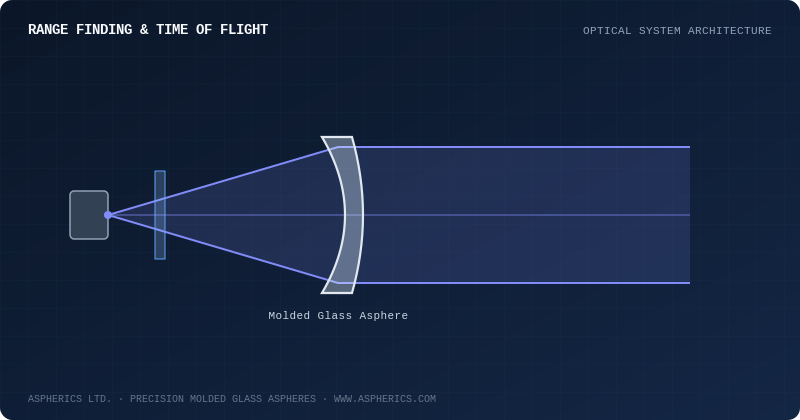
<p>The transmit asphere collimates the pulsed diode; its focal length is chosen from the emitter width and the spot required at range. The receive lens focuses the return onto an avalanche photodiode or SPAD; its diameter is usually larger than the transmit lens.</p><p>For compact industrial sensors the transmit channel can be a laser diode module, pre-aligned with pointing ≤ 1 mrad to its body, so that the transmitter and receiver axes are set by the housing bores.</p>

Key Advantages
- Long focal lengths in the NIR. 12 to 32 mm designs at 780 to 976 nm keep the divergence of wide emitters small.
- Eye-safe band. 1550 nm designs with telecom coatings.
- Glass for outdoor use. Molded glass holds focal length over temperature and resists humidity and UV.
- Aligned transmitters. Laser diode modules give a transmit axis set by the module body.
Recommended Catalogue Parts
Molded Glass Aspheric Lenses
| Part Number | DWL | EFL | NA | Engineering Fit | Action |
|---|---|---|---|---|---|
| AL-D0930-F3199-W785 | 785 nm | 31.99 mm | 0.122 | 785 nm, Ø9.3 mm, EFL 31.99 mm, NA 0.122: a 200 µm pulsed emitter diverges about 6 mrad behind this lens. | |
| AL-D1250-F3199-W785 | 785 nm | 31.99 mm | 0.17 | 785 nm, Ø12.5 mm, EFL 31.99 mm, NA 0.17: a 200 µm pulsed emitter diverges about 6 mrad behind this lens. | |
| AL-D1600-F3000-W915 | 915 nm | 30 mm | 0.24 | 915 nm, Ø16 mm, EFL 30 mm, NA 0.24: a 200 µm pulsed emitter diverges about 7 mrad behind this lens. | |
| AL-D1200-F2400-W915 | 915 nm | 24 mm | 0.23 | 915 nm, Ø12 mm, EFL 24 mm, NA 0.23: a 200 µm pulsed emitter diverges about 8 mrad behind this lens. | |
| AL-D0650-F1839-W780 | 780 nm | 18.39 mm | 0.15 | 780 nm, Ø6.5 mm, EFL 18.39 mm, NA 0.15: a 200 µm pulsed emitter diverges about 11 mrad behind this lens. | |
| AL-D1000-F1670-W976 | 976 nm | 16.7 mm | 0.265 | 976 nm, Ø10 mm, EFL 16.7 mm, NA 0.265: a 200 µm pulsed emitter diverges about 12 mrad behind this lens. | |
| AL-D0650-F1529-W780 | 780 nm | 15.29 mm | 0.16 | 780 nm, Ø6.5 mm, EFL 15.29 mm, NA 0.16: a 200 µm pulsed emitter diverges about 13 mrad behind this lens. | |
| AL-D0200-F0500-W1550 | 1550 nm | 5 mm | 0.15 | 1550 nm, Ø2 mm, EFL 5 mm, NA 0.15: eye-safe 1550 nm transmitter; 100 µm emitter → 20 mrad. | |
| AL-D0279-F0613-W1550 | 1550 nm | 6.13 mm | 0.18 | 1550 nm, Ø2.79 mm, EFL 6.13 mm, NA 0.18: eye-safe 1550 nm transmitter; 100 µm emitter → 16 mrad. | |
| AL-D0240-F0114-W1310 | 1310 nm | 1.14 mm | 0.55 | 1310 nm, Ø2.4 mm, EFL 1.14 mm, NA 0.55: eye-safe 1550 nm transmitter; 100 µm emitter → 88 mrad. | |
| AL-D0650-F0750-W830 | 830 nm | 7.5 mm | 0.36 | 830 nm, Ø6.5 mm, EFL 7.5 mm, NA 0.36: a 200 µm pulsed emitter diverges about 27 mrad behind this lens. | |
| AL-D0635-F0643-W830 | 830 nm | 6.43 mm | 0.43 | 830 nm, Ø6.35 mm, EFL 6.43 mm, NA 0.43: a 200 µm pulsed emitter diverges about 31 mrad behind this lens. |
Mounted Aspheric Lenses
| Part Number | DWL | EFL | NA | Engineering Fit | Action |
|---|---|---|---|---|---|
| MAB-D0930-F3199-W785 | 785 nm | 31.99 mm | 0.122 | AL-D0930-F3199-W785 in a M14 / M12 ×0.5 barrel, 9 configurations: screw into the diode socket and focus by rotation. | |
| MAB-D1250-F3199-W785 | 785 nm | 31.99 mm | 0.17 | AL-D1250-F3199-W785 in a M18 ×0.5 barrel, 5 configurations: screw into the diode socket and focus by rotation. | |
| MAB-D1600-F3000-W915 | 915 nm | 30 mm | 0.24 | AL-D1600-F3000-W915 in a M20 ×0.5 barrel, 5 configurations: screw into the diode socket and focus by rotation. | |
| MAB-D1200-F2400-W915 | 915 nm | 24 mm | 0.23 | AL-D1200-F2400-W915 in a M18 ×0.5 barrel, 5 configurations: screw into the diode socket and focus by rotation. | |
| MAB-D0650-F1839-W780 | 780 nm | 18.39 mm | 0.15 | AL-D0650-F1839-W780 in a M12 / M10 / M9 ×0.5 barrel, 14 configurations: screw into the diode socket and focus by rotation. | |
| MAB-D1000-F1670-W976 | 976 nm | 16.7 mm | 0.265 | AL-D1000-F1670-W976 in a M14 / M12 ×0.5 barrel, 9 configurations: screw into the diode socket and focus by rotation. | |
| MAB-D0650-F1529-W780 | 780 nm | 15.29 mm | 0.16 | AL-D0650-F1529-W780 in a M12 / M10 / M9 ×0.5 barrel, 14 configurations: screw into the diode socket and focus by rotation. | |
| MAB-D0200-F0500-W1550 | 1550 nm | 5 mm | 0.15 | AL-D0200-F0500-W1550 in a M12 / M9 / M5 ×0.5 barrel, 12 configurations: screw into the diode socket and focus by rotation. |
Laser Diode Modules
| Part Number | DWL | EFL | NA | Engineering Fit | Action |
|---|---|---|---|---|---|
| LDM-D0930-F3199-W785 | 785 nm | 31.99 mm | 0.122 | 785 nm diode aligned to AL-D0930-F3199-W785: Ø5.6 / Ø9 mm can, laser welded or uv epoxy, pointing ≤ 1 mrad. | |
| LDM-D1250-F3199-W785 | 785 nm | 31.99 mm | 0.17 | 785 nm diode aligned to AL-D1250-F3199-W785: Ø5.6 / Ø9 mm can, laser welded or uv epoxy, pointing ≤ 1 mrad. | |
| LDM-D1600-F3000-W915 | 915 nm | 30 mm | 0.24 | 915 nm diode aligned to AL-D1600-F3000-W915: Ø5.6 / Ø9 mm can, laser welded or uv epoxy, pointing ≤ 1 mrad. | |
| LDM-D1200-F2400-W915 | 915 nm | 24 mm | 0.23 | 915 nm diode aligned to AL-D1200-F2400-W915: Ø5.6 / Ø9 mm can, laser welded or uv epoxy, pointing ≤ 1 mrad. | |
| LDM-D0650-F1839-W780 | 780 nm | 18.39 mm | 0.15 | 780 nm diode aligned to AL-D0650-F1839-W780: Ø5.6 / Ø9 mm can, laser welded or uv epoxy, pointing ≤ 1 mrad. | |
| LDM-D1000-F1670-W976 | 976 nm | 16.7 mm | 0.265 | 976 nm diode aligned to AL-D1000-F1670-W976: Ø5.6 / Ø9 mm can, laser welded or uv epoxy, pointing ≤ 1 mrad. | |
| LDM-D0650-F1529-W780 | 780 nm | 15.29 mm | 0.16 | 780 nm diode aligned to AL-D0650-F1529-W780: Ø5.6 / Ø9 mm can, laser welded or uv epoxy, pointing ≤ 1 mrad. | |
| LDM-D0200-F0500-W1550 | 1550 nm | 5 mm | 0.15 | 1550 nm diode aligned to AL-D0200-F0500-W1550: Ø5.6 mm can, laser welded or uv epoxy, pointing ≤ 1 mrad. |
Frequently Asked Questions
Why is my rangefinder beam so divergent?
Pulsed diodes have wide emitters. The divergence is about emitter width divided by focal length, regardless of lens quality; a longer focal length is the only optical fix.
Can I use a 915 nm lens at 905 nm?
Yes. Both lie in the BBAR-NIR-I band; the lens page shows the small refocus between the lines.
Do you supply the receive optics?
Catalogue aspheres with high NA are often used as receive lenses for small detectors. Larger collection lenses are quoted to order.
Related Applications
Molded glass aspheres that turn a diode's divergent output into a clean, round-ish collimated beam, 405 to 1550 nm.
Telecom-band aspheres for fiber collimators, transceiver optics and free-space links at 1300 to 1550 nm.
Dot and line projectors for triangulation sensors, 3D profilers and structured-light vision.