
Correcting for the laser diode window
A plane window in a diverging beam shifts focus and adds spherical aberration that grows with the fourth power of NA. Why high-NA collimators are designed for one window.
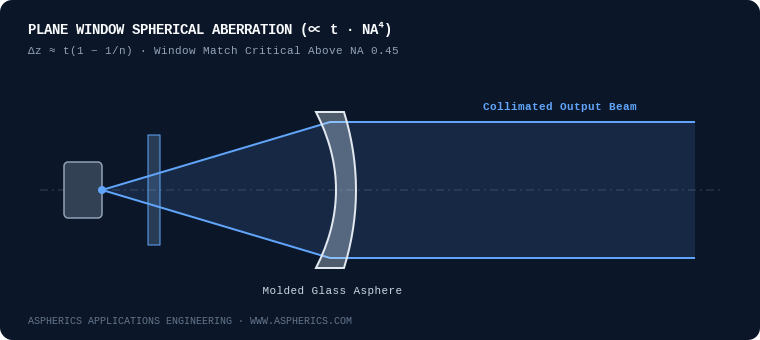
What the window does
Most TO-can diodes emit through a flat window in the cap. To the collimator, that window is a plane-parallel plate in a strongly diverging beam. It moves the apparent source away from the lens, and it adds spherical aberration, because rays at large angles are displaced more than rays near the axis.
Δz ≈ t (1 − 1/n) (paraxial) · Δz(θ) = t [1 − cos θ / √(n² − sin² θ)]
The paraxial shift is about a third of the window thickness: 93 µm for a 0.275 mm N-BK7 window at 780 nm, and about 0.45 mm for a 1.2 mm polycarbonate window at 445 nm. Refocusing the lens removes the shift. It does not remove the aberration, which is the difference between the marginal and the paraxial shift.
Why NA decides
The primary spherical aberration of a plate scales as t (n² − 1) / n³ · NA⁴. Doubling the NA multiplies it by sixteen. Below an NA of about 0.3, a window error of a few tenths of a millimetre hardly matters. Above about 0.45, the window must be part of the lens design.
Catalogue examples
RMS wavefront error at the design wavelength and best focus, from the design ray trace (the window chart on each lens page):
| Lens | NA | Design window | At design window | 0.25 mm | No window |
|---|---|---|---|---|---|
| AL-D0470-F0616-W780 | 0.30 | 0.275 mm N-BK7 | < 0.01 λ | < 0.01 λ | 0.010 λ |
| AL-D0542-F0447-W780 | 0.47 | 1.2 mm PC | < 0.01 λ | 0.24 λ | 0.31 λ |
| AL-D06325-F0390-W780 | 0.50 | 1.2 mm N-BK7 | < 0.01 λ | 0.32 λ | 0.42 λ |
| AL-D0633-F0405-W445 | 0.63 | 1.2 mm PC | < 0.01 λ | 1.58 λ | 2.07 λ |
The diffraction limit by the Maréchal criterion is 0.071 λ RMS. The NA 0.30 lens stays far inside it with any window up to 0.5 mm. The NA 0.47 lens exceeds it when its 1.2 mm window is replaced by a 1.5 mm one. The NA 0.63 lens is unusable without its window. The reverse also holds: a windowless high-NA design must not be used behind a window.
Matching a lens to your diode
- Read the window material and thickness from the diode datasheet, or measure a sample cap.
- Choose a lens designed for that window. The lens page states the design window and plots wavefront error against thickness.
- For an open or cap-less emitter, choose a windowless design.
- Above NA 0.45, treat a few tenths of a millimetre of thickness difference as significant and check the chart.
- For a window that no catalogue lens matches, a catalogue profile can be re-optimised; see custom lens development.
Frequently Asked Questions
Can I remove the window and keep the same lens?
Only on low-NA lenses. A high-NA lens carries the window correction in its profile; without the window that correction remains as aberration, 2.07 λ RMS on AL-D0633-F0405-W445.
Does the window material matter, or only its thickness?
Both. The aberration depends on the refractive index: polycarbonate (about 1.57 to 1.62 across 400–800 nm) and N-BK7 (about 1.51) of the same thickness differ.
Recommended Catalogue Parts
Related Technical Notes
Focal length sets the beam size, NA sets how much of the fast axis is captured, and the emitter sets the divergence. With a worked example from the catalogue.
What an RMS wavefront specification at 632.8 nm means for beam quality, how to convert it between wavelengths and how it relates to surface form.
Why a collimated diode beam points off-axis, how active alignment sets focus and pointing on the live beam, and what the fixing method changes.