
Selecting a collimating lens for a laser diode
Focal length sets the beam size, NA sets how much of the fast axis is captured, and the emitter sets the divergence. With a worked example from the catalogue.
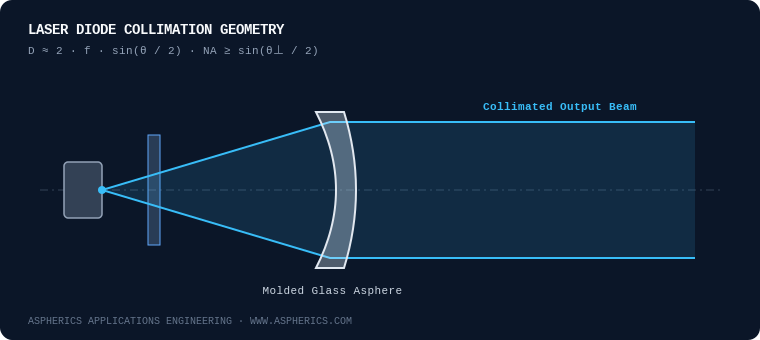
Beam size and focal length
A laser diode emits an elliptical cone: wide in the fast axis, perpendicular to the junction, and narrow in the slow axis. Datasheets give both as full angles at half maximum (FWHM). For a near-Gaussian far field, the full angle at the 1/e² intensity points is about 1.7 × FWHM.
An aspheric collimator satisfies the sine condition: a ray leaving the emitter at angle θ to the axis leaves the lens at height f · sin θ. The 1/e² beam diameter in each axis is therefore
D ≈ 2 · f · sin(θ1/e² / 2)
Choose the focal length from the beam diameter you need in the fast axis. The slow-axis diameter follows from the same lens, and the ratio of the two is the ellipticity of the collimated beam.
Numerical aperture
The NA of a collimator is the sine of the largest emission half-angle its clear aperture accepts. To pass the fast axis to its 1/e² points:
NA ≥ sin(θ⊥, 1/e² / 2)
A lens with a smaller NA clips the fast axis. Clipped at its 1/e² points, a Gaussian axis passes about 95 % of its power; clipped at 70 % of that height, about 84 %. Clipping also adds weak diffraction rings to the far field. Where the full beam is not needed, as in a pointer or a level, it can be an acceptable trade for a longer focal length or a smaller lens.
Residual divergence
After collimation the beam still diverges, for two reasons. The source has a finite size: an emitter of width w behind a lens of focal length f gives a full angle of about w / f. And the beam has a finite diameter: a Gaussian beam of 1/e² diameter D diffracts at 4λ / (πD) full angle.
θgeo ≈ w / f · θdiff ≈ 4λ / (π D)
Single-mode diodes come close to the diffraction term in both axes. Broad-area diodes are set by the geometric term in the slow axis: a 100 µm emitter behind a 15 mm lens diverges at about 6.7 mrad, whatever the quality of the lens. Only a longer focal length reduces it, and the beam grows in proportion.
Working distance and window
The lens has to reach focus with the diode cap in place, so its working distance must clear the cap. High-NA collimators are also corrected for the window the beam passes through: above an NA of about 0.45, a lens designed for another window thickness or material loses wavefront quality. See correcting for the laser diode window.
Worked example
A 780 nm single-mode diode with a far field of 30° × 9° FWHM, collimated by AL-D0542-F0447-W780 (f = 4.47 mm, NA 0.47):
| Quantity | Relation | Fast axis | Slow axis |
|---|---|---|---|
| 1/e² full angle | 1.7 × FWHM | 51° | 15.3° |
| NA needed | sin(θ / 2) | 0.43 | 0.13 |
| Beam diameter | 2 f sin(θ / 2) | 3.85 mm | 1.19 mm |
| Diffraction divergence | 4λ / (π D) | 0.26 mrad | 0.84 mrad |
The lens NA of 0.47 passes the fast axis. The beam is 3.2 : 1 elliptical, and the narrow slow axis diverges more than the wide fast axis. This lens is corrected for a 1.2 mm polycarbonate window, so check the diode cap first.
AL-D0470-F0616-W780 (f = 6.16 mm, NA 0.30) gives a larger beam, but it accepts only ±17.5°. With the same diode it clips the fast axis at 70 % of its 1/e² height and passes about 84 % of the power in that axis.
Selection checklist
- Wavelength. A design wavelength in the same band. The lens page shows the refocus across the coating band.
- NA. At least sin(θ⊥ / 2) of the fast axis at 1/e², unless clipping is acceptable.
- Focal length. From the fast-axis beam diameter; then check the slow-axis size and the divergence.
- Window. Same material and thickness as the lens design.
- Working distance. Clears the diode cap.
- Coating. Matched to the wavelength; see choosing an anti-reflection coating.
- Supply form. A bare lens, a mounted lens that you focus, or a laser diode module aligned on the beam.
The collimating lens finder applies these relations to every catalogue lens.
Frequently Asked Questions
Should I choose the lens by NA or by focal length?
By both. The focal length sets the beam size and the divergence; the NA must then be large enough for the fast axis at that focal length. If no lens meets both, either accept some clipping or change the beam-size target.
Why is the collimated beam elliptical?
The fast and slow axes leave the diode at different angles, so one lens gives two diameters. Anamorphic prisms or cylindrical optics make it round; an aperture trims it at a cost in power.
Can I use a collimator designed for another wavelength?
Within its coating band, yes, with refocus. The lens page shows the focus shift across the band. Wavefront quality is best near the design wavelength.
Recommended Catalogue Parts
Related Technical Notes
A plane window in a diverging beam shifts focus and adds spherical aberration that grows with the fourth power of NA. Why high-NA collimators are designed for one window.
What an RMS wavefront specification at 632.8 nm means for beam quality, how to convert it between wavelengths and how it relates to surface form.
Why a collimated diode beam points off-axis, how active alignment sets focus and pointing on the live beam, and what the fixing method changes.