
Choosing an anti-reflection coating
Fresnel loss, back-reflection into the diode and angle of incidence: when to use a broadband, narrow-band or V-coat on a molded collimator.
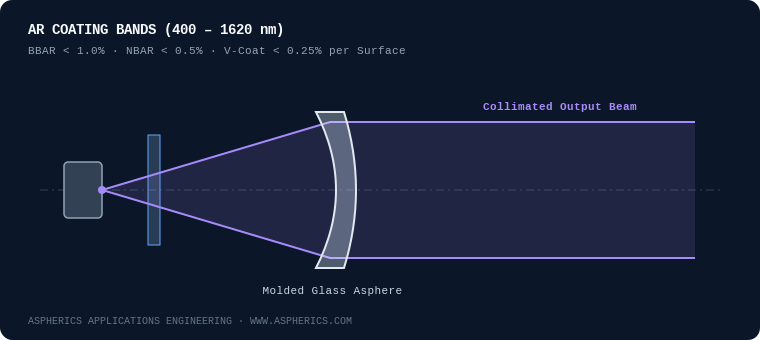
Why coat a collimator
At normal incidence an uncoated surface reflects
R = ((n − 1) / (n + 1))²
That is 4.0 % at n = 1.50, 5.2 % for D-ZK3 (n ≈ 1.59) and 8.3 % for D-ZLAF52LA (n ≈ 1.81). Through two uncoated surfaces a lens transmits about 90 % and 84 % respectively. The reflected light also returns toward the emitter, where a single-mode diode can respond with mode hops, intensity noise or wavelength jitter.
Coating types
| Coating | Band, nm | Reflectance per surface | Two surfaces, T ≥ |
|---|---|---|---|
| BBAR-VIS | 400–700 | R < 1.0 % average | 98.0 % |
| BBAR-NIR-I | 650–1050 | R < 1.0 % average | 98.0 % |
| BBAR-NIR-II | 1050–1620 | R < 1.0 % average | 98.0 % |
| NBAR-VIO | 400–470 | R < 0.5 % average | 99.0 % |
| NBAR-GRN | 510–545 | R < 0.5 % average | 99.0 % |
| NBAR-RED | 620–670 | R < 0.5 % average | 99.0 % |
| NBAR-NIR-A | 760–850 | R < 0.5 % average | 99.0 % |
| NBAR-NIR-B | 900–990 | R < 0.5 % average | 99.0 % |
| NBAR-TEL | 1290–1570 | R < 0.5 % average | 99.0 % |
| V-coat | one line | R < 0.25 % at the line | 99.5 % |
Transmission figures count reflection only, not absorption. Each lens page lists the coatings offered for that lens and marks the standard one.
Which one to choose
- One fixed line, lowest loss and back-reflection: V-coat, centred on the line.
- One line with tolerance: NBAR. Diode wavelengths vary from part to part and drift with temperature, about 0.2–0.3 nm/K for red and near-infrared Fabry–Pérot diodes.
- Several lines, or a source not yet chosen: BBAR across the band.
A V-coat's reflectance rises steeply on either side of its line, so it suits sources whose wavelength is known and stable.
Angle of incidence on high-NA lenses
The specifications hold at 0° ± 5°. On a high-NA collimator, rays near the rim of the diode-side surface meet it far from normal incidence. There the reflectance is higher, and the spectral curve moves toward shorter wavelengths as the angle grows. A broadband or narrow-band coating tolerates this better than a V-coat.
Durability and laser damage
Coatings meet MIL-PRF-13830B for adhesion, humidity and moderate abrasion. Some catalogue lenses carry a laser damage threshold of 1000 W/cm²; the others are not rated (ISO 10110-17 code 6/–), and the lens page states which applies. Give a damage requirement with the quote. Coating is part of every released lens; see optical coatings.
Frequently Asked Questions
Is a V-coat always the best choice?
Only for one fixed wavelength near normal incidence. Away from its line, or at large angles of incidence, its reflectance rises faster than that of a narrow-band coating.
Can only one side be coated?
Yes. Coatings are applied to both surfaces unless single-side coating is specified with the quote.
Can you coat for a wavelength that is not listed?
Yes. Narrow-band and V-coats can be centred on your line within the substrate's transmission band. Give the wavelength and angle of incidence with the quote.
Recommended Catalogue Parts
Related Technical Notes
Focal length sets the beam size, NA sets how much of the fast axis is captured, and the emitter sets the divergence. With a worked example from the catalogue.
What an RMS wavefront specification at 632.8 nm means for beam quality, how to convert it between wavelengths and how it relates to surface form.
Codes 0/ to 6/ explained with values from catalogue drawings: stress birefringence, bubbles, homogeneity, form, centring, surface imperfections and laser damage.