
Optical coatings
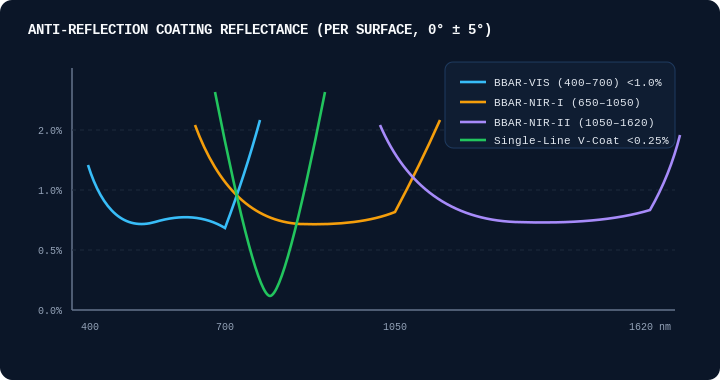
Anti-reflection coatings selected for the operating wavelength: broadband for several lines, narrow-band or V-coat for one.
Coating selection
An uncoated glass surface reflects about 5 % at normal incidence, and more for high-index glasses. A collimator has two surfaces, so coating is part of every released lens, chosen with the quote: broadband (BBAR) when the source may change or several lines share the lens, narrow-band (NBAR) for one line in a known region, and a V-coat when one wavelength must have the lowest loss and back-reflection.
Each catalogue lens lists the coatings it is offered with and marks the standard one. Coatings are applied to both surfaces unless one side is specified. Selection is explained in choosing an anti-reflection coating.
Controlled Process Specifications
Related Technical Notes
Fresnel loss, back-reflection into the diode and angle of incidence: when to use a broadband, narrow-band or V-coat on a molded collimator.
Focal length sets the beam size, NA sets how much of the fast axis is captured, and the emitter sets the divergence. With a worked example from the catalogue.
What an RMS wavefront specification at 632.8 nm means for beam quality, how to convert it between wavelengths and how it relates to surface form.
Frequently Asked Questions
Can you coat for a wavelength that is not listed?
Yes. Narrow-band and V-coats are centred on your line within the substrate's transmission band; give the wavelength and angle of incidence with the quote.
Are the coatings rated for laser damage?
Some catalogue lenses carry a threshold of 1000 W/cm²; the others are not rated (ISO 10110-17 code 6/–), and the lens page states which applies. Give your power density and pulse format with the quote.
Ready for DFM Review or Custom Production Quote?
Send your ISO 10110 drawing, Zemax file, or optical target specification. NDA available on request.