
Atomic Physics & Quantum Sensing
Collimators for 780 and 795 nm rubidium and 852 / 894 nm caesium lasers in clocks, magnetometers and cold-atom systems.
Optical Requirements & Rationale
The lines
The rubidium D2 line lies at 780.24 nm and D1 at 794.98 nm; caesium D2 at 852.35 nm and D1 at 894.59 nm. Diode lasers reach them directly, stabilised by an external cavity (a grating or interference filter feedback) or by a distributed feedback structure, then locked to the atomic line through spectroscopy in a vapor cell.
What the lens does
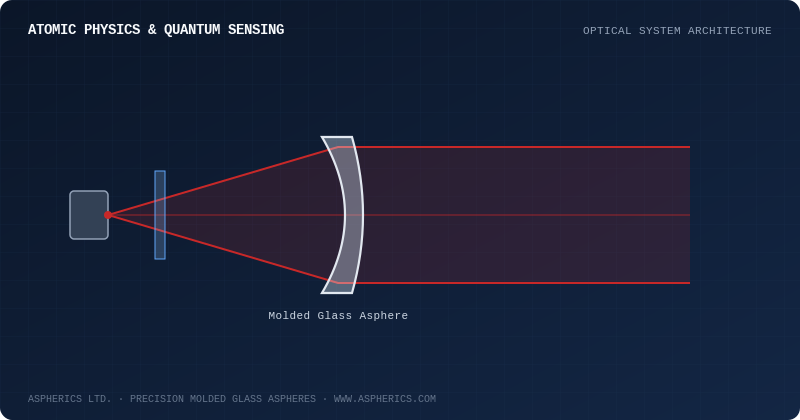
In an external-cavity laser, the collimating lens forms part of the cavity: its quality and stability affect the feedback, the tuning range and the mode stability. At the output, the beam is shaped to the vapor cell or the trap. In chip-scale clocks and magnetometers, a short focal-length asphere expands the VCSEL beam to the cell aperture.
<p>An external-cavity laser collimates the diode with a short-EFL, high-NA asphere and returns part of the light from a grating or filter. The output passes an isolator, then a beam splitter sends part to a saturated-absorption reference cell and the rest to the experiment or sensor cell.</p><p>780 nm designs serve the Rb D2 line directly; the D1 line at 795 nm and the Cs lines at 852 and 894 nm are inside the BBAR-NIR-I band and need only the refocus plotted on each lens page.</p>

Key Advantages
- On the Rb D2 line. 780 nm designs with a V-780 option.
- Refocus data for D1 and Cs. Focus shift to 795, 852 and 894 nm plotted per lens.
- Glass for stability. Molded glass keeps the focal length stable in temperature-controlled cavities.
- Welded modules. Adhesive-free sources for vacuum-adjacent and outgassing-sensitive builds.
Recommended Catalogue Parts
Molded Glass Aspheric Lenses
| Part Number | DWL | EFL | NA | Engineering Fit | Action |
|---|---|---|---|---|---|
| AL-D0300-F0200-W780 | 780 nm | 2 mm | 0.5 | 780 nm, Ø3 mm, EFL 2 mm, NA 0.5: Rb D2 780 nm directly; V-780 available. | |
| AL-D0400-F0273-W780 | 780 nm | 2.73 mm | 0.55 | 780 nm, Ø4 mm, EFL 2.73 mm, NA 0.55: Rb D2 780 nm directly; V-780 available. | |
| AL-D0720-F0624-W780 | 780 nm | 6.24 mm | 0.4 | 780 nm, Ø7.2 mm, EFL 6.24 mm, NA 0.4: Rb D2 780 nm directly; V-780 available. | |
| AL-D0240-F0145-W780 | 780 nm | 1.45 mm | 0.56 | 780 nm, Ø2.4 mm, EFL 1.45 mm, NA 0.56: Rb D2 780 nm directly; V-780 available. | |
| AL-D06325-F0390-W780 | 780 nm | 3.9 mm | 0.5 | 780 nm, Ø6.325 mm, EFL 3.9 mm, NA 0.5: Rb D2 780 nm directly; V-780 available. | |
| AL-D0635-F0643-W830 | 830 nm | 6.43 mm | 0.43 | 830 nm, Ø6.35 mm, EFL 6.43 mm, NA 0.43: 830 nm design, refocus for Rb D1 / Cs lines; V-830 available. | |
| AL-D0950-F2406-W785 | 785 nm | 24.06 mm | 0.16 | 785 nm, Ø9.5 mm, EFL 24.06 mm, NA 0.16: 785 nm design, refocus for Rb D1 / Cs lines; V-785 available. | |
| AL-D0930-F3199-W785 | 785 nm | 31.99 mm | 0.122 | 785 nm, Ø9.3 mm, EFL 31.99 mm, NA 0.122: 785 nm design, refocus for Rb D1 / Cs lines; V-785 available. | |
| AL-D0450-F0275-W830 | 830 nm | 2.75 mm | 0.64 | 830 nm, Ø4.5 mm, EFL 2.75 mm, NA 0.64: 830 nm design, refocus for Rb D1 / Cs lines; V-830 available. | |
| AL-D06325-F0310-W830 | 830 nm | 3.1 mm | 0.67 | 830 nm, Ø6.325 mm, EFL 3.1 mm, NA 0.67: 830 nm design, refocus for Rb D1 / Cs lines; V-830 available. | |
| AL-D1250-F3199-W785 | 785 nm | 31.99 mm | 0.17 | 785 nm, Ø12.5 mm, EFL 31.99 mm, NA 0.17: 785 nm design, refocus for Rb D1 / Cs lines; V-785 available. | |
| AL-D0650-F0750-W830 | 830 nm | 7.5 mm | 0.36 | 830 nm, Ø6.5 mm, EFL 7.5 mm, NA 0.36: 830 nm design, refocus for Rb D1 / Cs lines; V-830 available. |
Mounted Aspheric Lenses
| Part Number | DWL | EFL | NA | Engineering Fit | Action |
|---|---|---|---|---|---|
| MAB-D0300-F0200-W780 | 780 nm | 2 mm | 0.5 | AL-D0300-F0200-W780 in a M12 / M9 / M7 ×0.5 barrel, 12 configurations: screw into the diode socket and focus by rotation. | |
| MAB-D0720-F0624-W780 | 780 nm | 6.24 mm | 0.4 | AL-D0720-F0624-W780 in a M12 / M10 / M9 ×0.5 barrel, 13 configurations: screw into the diode socket and focus by rotation. | |
| MAB-D06325-F0390-W780 | 780 nm | 3.9 mm | 0.5 | AL-D06325-F0390-W780 in a M12 / M10 ×0.5 barrel, 9 configurations: screw into the diode socket and focus by rotation. | |
| MAB-D0635-F0643-W830 | 830 nm | 6.43 mm | 0.43 | AL-D0635-F0643-W830 in a M12 / M10 / M9 ×0.5 barrel, 14 configurations: screw into the diode socket and focus by rotation. | |
| MAB-D0950-F2406-W785 | 785 nm | 24.06 mm | 0.16 | AL-D0950-F2406-W785 in a M14 / M12 ×0.5 barrel, 9 configurations: screw into the diode socket and focus by rotation. | |
| MAB-D0930-F3199-W785 | 785 nm | 31.99 mm | 0.122 | AL-D0930-F3199-W785 in a M14 / M12 ×0.5 barrel, 9 configurations: screw into the diode socket and focus by rotation. | |
| MAB-D1250-F3199-W785 | 785 nm | 31.99 mm | 0.17 | AL-D1250-F3199-W785 in a M18 ×0.5 barrel, 5 configurations: screw into the diode socket and focus by rotation. | |
| MAB-D0650-F0750-W830 | 830 nm | 7.5 mm | 0.36 | AL-D0650-F0750-W830 in a M12 / M10 / M9 ×0.5 barrel, 14 configurations: screw into the diode socket and focus by rotation. |
Laser Diode Modules
| Part Number | DWL | EFL | NA | Engineering Fit | Action |
|---|---|---|---|---|---|
| LDM-D0300-F0200-W780 | 780 nm | 2 mm | 0.5 | 780 nm diode aligned to AL-D0300-F0200-W780: Ø5.6 mm can, laser welded or uv epoxy, pointing ≤ 1 mrad. | |
| LDM-D0720-F0624-W780 | 780 nm | 6.24 mm | 0.4 | 780 nm diode aligned to AL-D0720-F0624-W780: Ø5.6 / Ø9 mm can, laser welded or uv epoxy, pointing ≤ 1 mrad. | |
| LDM-D06325-F0390-W780 | 780 nm | 3.9 mm | 0.5 | 780 nm diode aligned to AL-D06325-F0390-W780: Ø5.6 / Ø9 mm can, laser welded or uv epoxy, pointing ≤ 1 mrad. | |
| LDM-D0635-F0643-W830 | 830 nm | 6.43 mm | 0.43 | 830 nm diode aligned to AL-D0635-F0643-W830: Ø5.6 / Ø9 mm can, laser welded or uv epoxy, pointing ≤ 1 mrad. | |
| LDM-D0950-F2406-W785 | 785 nm | 24.06 mm | 0.16 | 785 nm diode aligned to AL-D0950-F2406-W785: Ø5.6 / Ø9 mm can, laser welded or uv epoxy, pointing ≤ 1 mrad. | |
| LDM-D0930-F3199-W785 | 785 nm | 31.99 mm | 0.122 | 785 nm diode aligned to AL-D0930-F3199-W785: Ø5.6 / Ø9 mm can, laser welded or uv epoxy, pointing ≤ 1 mrad. | |
| LDM-D1250-F3199-W785 | 785 nm | 31.99 mm | 0.17 | 785 nm diode aligned to AL-D1250-F3199-W785: Ø5.6 / Ø9 mm can, laser welded or uv epoxy, pointing ≤ 1 mrad. | |
| LDM-D0650-F0750-W830 | 830 nm | 7.5 mm | 0.36 | 830 nm diode aligned to AL-D0650-F0750-W830: Ø5.6 / Ø9 mm can, laser welded or uv epoxy, pointing ≤ 1 mrad. |
Frequently Asked Questions
Can I use a 780 nm lens at 795 or 852 nm?
Yes. Both lines are inside the BBAR-NIR-I and NBAR-NIR-A bands; the lens page shows the refocus, typically some micrometres.
Is the lens suitable inside an external cavity?
Yes: choose a high-NA design with low specified wavefront error and a V-coat at the line to minimise unwanted reflections.
Do you build laser heads?
We supply lenses and aligned diode-lens modules. External-cavity heads are built by our customers on these parts.
Related Applications
Molded glass aspheres that turn a diode's divergent output into a clean, round-ish collimated beam, 405 to 1550 nm.
High-NA aspheres for diode-to-fiber coupling, fiber collimators and 915 / 976 nm pump optics.
Excitation collimators and collection optics for Raman and fluorescence spectrometers at 532, 785 and 830 nm.
Collimated diode sources for laser encoders, interferometric position sensors and alignment metrology.