
Fiber Coupling & Pump Diodes
High-NA aspheres for diode-to-fiber coupling, fiber collimators and 915 / 976 nm pump optics.
Optical Requirements & Rationale
Acceptance and mode matching
A fiber accepts light only inside a cone set by its numerical aperture: about 0.12 to 0.14 for standard single-mode fiber, 0.15 to 0.22 for most multimode delivery fibers, up to 0.46 for the pump cladding of double-clad fiber. Multimode coupling is mainly a geometric problem: the image of the emitter must fit inside the core, and the focusing cone inside the fiber NA.
Single-mode coupling is a field-overlap problem. The focused spot must match the fiber mode field diameter (about 9 µm at 1310 nm, 10.4 µm at 1550 nm) in size, position and angle. Wavefront error, astigmatism of the diode and lateral offset all reduce the overlap; a diode with a 3:1 elliptical beam couples poorly into a round mode unless the ellipticity is corrected.
One lens or two
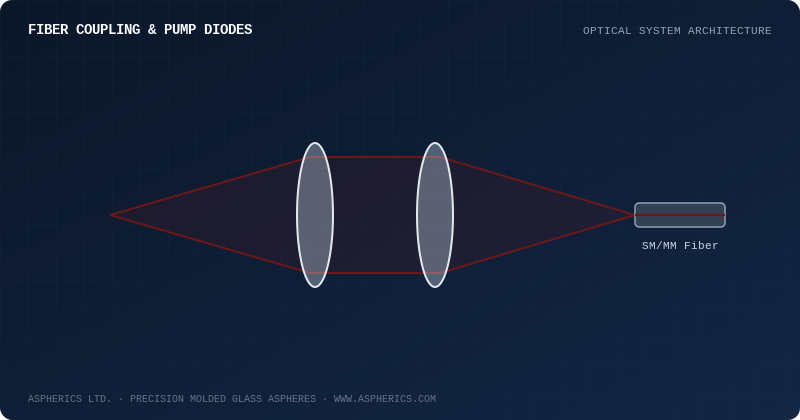
A single asphere imaging the emitter onto the fiber is the most compact layout, but the magnification and both working distances are fixed by one part. Two aspheres, a collimator and a focusing lens, set the magnification by the ratio of their focal lengths and leave a collimated space for an isolator, a filter or a beam-shaping prism pair. The collimated space also makes alignment far less sensitive to the axial position of the second lens.
<p>For a fiber-coupled diode, the collimating asphere sits one working distance from the emitter; the focusing asphere is chosen so that EFL<sub>focus</sub> ÷ EFL<sub>collimator</sub> magnifies the emitter mode onto the fiber mode. The fiber ferrule is aligned on the live signal and fixed by laser welding or UV epoxy.</p><p>For a fiber collimator, a single asphere sits one focal length from the polished fiber end; the output beam diameter is about 2 × EFL × NA<sub>fiber</sub>. A telecom pigtail collimator with a 2 mm lens gives roughly a 0.5 mm beam; a 15 mm lens gives about 3.5 mm, for longer free-space paths.</p><p>Pump diodes at 915 and 976 nm are usually supplied already fiber-coupled; the asphere then collimates the delivery-fiber output into the pump optics of a fiber or solid-state laser.</p>

Key Advantages
- High NA available. Designs up to NA 0.6 and above capture the full fast axis of the diode, so coupling losses come from mode mismatch, not clipping.
- Telecom and pump wavelengths. 1300 / 1310 / 1550 nm designs with NBAR-TEL, and windowless 915 / 976 nm designs for pump-fiber collimation.
- Collimator–focuser pairs from one catalogue. Lenses at the same wavelength cover EFLs from about 1 to 32 mm, so the magnification can be set by choosing two catalogue parts.
- Engineered fiber modules. When you want the alignment done, we build diode-to-fiber and fiber-output modules to order on the same alignment process as our standard modules.
Recommended Catalogue Parts
Molded Glass Aspheric Lenses
| Part Number | DWL | EFL | NA | Engineering Fit | Action |
|---|---|---|---|---|---|
| AL-D1200-F2400-W915 | 915 nm | 24 mm | 0.23 | 915 nm, Ø12 mm, EFL 24 mm, NA 0.23: collimates NA 0.22 pump-fiber output to about 10.6 mm. | |
| AL-D1600-F3000-W915 | 915 nm | 30 mm | 0.24 | 915 nm, Ø16 mm, EFL 30 mm, NA 0.24: collimates NA 0.22 pump-fiber output to about 13.2 mm. | |
| AL-D0200-F0500-W1550 | 1550 nm | 5 mm | 0.15 | 1550 nm, Ø2 mm, EFL 5 mm, NA 0.15: collimates SMF output to about 1.2 mm; coat NBAR-TEL or V-1550. | |
| AL-D1000-F1670-W976 | 976 nm | 16.7 mm | 0.265 | 976 nm, Ø10 mm, EFL 16.7 mm, NA 0.265: collimates NA 0.22 pump-fiber output to about 7.3 mm. | |
| AL-D0400-F0273-W780 | 780 nm | 2.73 mm | 0.55 | 780 nm, Ø4 mm, EFL 2.73 mm, NA 0.55: NA 0.55 captures the full fast axis as the collimator of a two-lens coupling stage. | |
| AL-D0240-F0114-W1300 | 1300 nm | 1.14 mm | 0.43 | 1300 nm, Ø2.4 mm, EFL 1.14 mm, NA 0.43: collimates SMF output to about 0.3 mm; coat NBAR-TEL or V-1300. | |
| AL-D0240-F0114-W1310 | 1310 nm | 1.14 mm | 0.55 | 1310 nm, Ø2.4 mm, EFL 1.14 mm, NA 0.55: collimates SMF output to about 0.3 mm; coat NBAR-TEL or V-1310. | |
| AL-D0300-F0220-W520 | 520 nm | 2.2 mm | 0.55 | 520 nm, Ø3 mm, EFL 2.2 mm, NA 0.55: NA 0.55 captures the full fast axis as the collimator of a two-lens coupling stage. | |
| AL-D06325-F0310-W830 | 830 nm | 3.1 mm | 0.67 | 830 nm, Ø6.325 mm, EFL 3.1 mm, NA 0.67: NA 0.67 captures the full fast axis as the collimator of a two-lens coupling stage. | |
| AL-D0633-F0405-W445 | 445 nm | 4.05 mm | 0.63 | 445 nm, Ø6.33 mm, EFL 4.05 mm, NA 0.63: NA 0.63 captures the full fast axis as the collimator of a two-lens coupling stage. | |
| AL-D1500-F1124-W587 | 587 nm | 11.24 mm | 0.62 | 587 nm, Ø15 mm, EFL 11.24 mm, NA 0.62: NA 0.62 captures the full fast axis as the collimator of a two-lens coupling stage. | |
| AL-D06325-F0402-W408 | 408 nm | 4.02 mm | 0.6 | 408 nm, Ø6.325 mm, EFL 4.02 mm, NA 0.6: NA 0.6 captures the full fast axis as the collimator of a two-lens coupling stage. | |
| AL-D0500-F0337-W808 | 808 nm | 3.37 mm | 0.31 |
Frequently Asked Questions
What coupling efficiency can I expect?
Into multimode fiber, with the emitter image inside the core and the cone inside the fiber NA, losses are dominated by Fresnel reflection and alignment, and high efficiency is normal. Into single-mode fiber, the limit is the mode overlap: an elliptical, astigmatic diode beam couples much less well than a round Gaussian unless it is corrected before the focusing lens.
Why two lenses instead of one?
Two lenses separate the two jobs: the collimator captures the diode at its own NA, the focusing lens sets the spot for the fiber. The ratio of focal lengths sets the magnification, and the collimated space between them takes isolators or filters and makes axial alignment forgiving.
Can you supply the lenses as a matched pair?
Yes. Name the two part numbers or the magnification you need and we quote them together, coated for your line.
Do you build fiber-coupled modules?
Yes, to order: diode-to-fiber coupling modules and fiber-output collimators, aligned on the live signal. See the engineered designs on the laser diode modules page.
Related Applications
Molded glass aspheres that turn a diode's divergent output into a clean, round-ish collimated beam, 405 to 1550 nm.
Telecom-band aspheres for fiber collimators, transceiver optics and free-space links at 1300 to 1550 nm.
Excitation collimators and collection optics for Raman and fluorescence spectrometers at 532, 785 and 830 nm.