
Spectroscopy & Raman Excitation
Excitation collimators and collection optics for Raman and fluorescence spectrometers at 532, 785 and 830 nm.
Optical Requirements & Rationale
Choosing the excitation line
Raman scattering grows as the fourth power of frequency, so shorter wavelengths give more signal, but many samples fluoresce under green light. 785 nm is the usual compromise for chemicals, pharmaceuticals and food; 830 nm and 1064 nm reduce fluorescence further for coloured or biological samples; 532 nm suits inorganic and carbon materials.
The optics
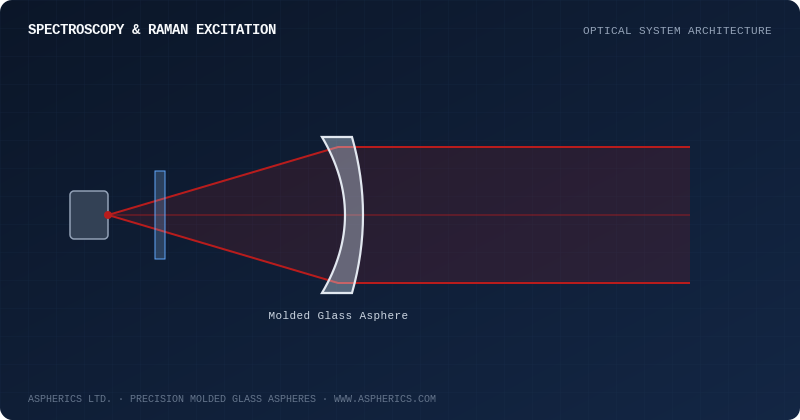
Raman lasers are wavelength-stabilised diodes (often with a volume Bragg grating) delivered in free space or through fiber. The excitation lens collimates them; a laser-line filter cleans the spectrum; a dichroic or edge filter separates the returning Raman light, and a collection lens couples it into the spectrometer fiber. High NA on the collection side gathers more of the weak signal.
<p>In a typical probe, an asphere collimates the excitation from the laser or its delivery fiber, a band-pass filter passes only the laser line, and a dichroic reflects it to a focusing lens at the sample. The scattered light returns through the same lens, passes the dichroic and a long-pass filter, and a second asphere focuses it into the collection fiber.</p><p>Collimated spaces between the lenses make room for the filters, which need near-normal incidence to keep their edges sharp.</p>

Key Advantages
- Raman lines covered. Designs at 532, 785 and 830 nm with line V-coats, R < 0.25 % per surface.
- Compact probes. Short focal lengths keep the collimated filter path small.
- Low fluorescence glass. Molded optical glass, without the autofluorescence of many polymers.
- Laser modules to order. Diode and lens aligned and fixed, as the excitation source of a probe.
Recommended Catalogue Parts
Molded Glass Aspheric Lenses
| Part Number | DWL | EFL | NA | Engineering Fit | Action |
|---|---|---|---|---|---|
| AL-D0950-F2406-W785 | 785 nm | 24.06 mm | 0.16 | 785 nm excitation: 785 nm, Ø9.5 mm, EFL 24.06 mm, NA 0.16, V-785 available. | |
| AL-D0930-F3199-W785 | 785 nm | 31.99 mm | 0.122 | 785 nm excitation: 785 nm, Ø9.3 mm, EFL 31.99 mm, NA 0.122, V-785 available. | |
| AL-D0300-F0200-W780 | 780 nm | 2 mm | 0.5 | 780 nm excitation: 780 nm, Ø3 mm, EFL 2 mm, NA 0.5, V-780 available. | |
| AL-D0635-F0643-W830 | 830 nm | 6.43 mm | 0.43 | 830 nm excitation: 830 nm, Ø6.35 mm, EFL 6.43 mm, NA 0.43, V-830 available. | |
| AL-D0800-F2258-W532 | 532 nm | 22.58 mm | 0.15 | 532 nm excitation: 532 nm, Ø8 mm, EFL 22.58 mm, NA 0.15, V-532 available. | |
| AL-D0400-F0273-W780 | 780 nm | 2.73 mm | 0.55 | 780 nm excitation: 780 nm, Ø4 mm, EFL 2.73 mm, NA 0.55, V-780 available. | |
| AL-D0650-F0750-W830 | 830 nm | 7.5 mm | 0.36 | 830 nm excitation: 830 nm, Ø6.5 mm, EFL 7.5 mm, NA 0.36, V-830 available. | |
| AL-D1250-F3199-W785 | 785 nm | 31.99 mm | 0.17 | 785 nm excitation: 785 nm, Ø12.5 mm, EFL 31.99 mm, NA 0.17, V-785 available. | |
| AL-D0470-F0616-W780 | 780 nm | 6.16 mm | 0.3 | 780 nm excitation: 780 nm, Ø4.7 mm, EFL 6.16 mm, NA 0.3, V-780 available. | |
| AL-D0720-F0624-W780 | 780 nm | 6.24 mm | 0.4 | 780 nm excitation: 780 nm, Ø7.2 mm, EFL 6.24 mm, NA 0.4, V-780 available. | |
| AL-D0450-F0275-W830 | 830 nm | 2.75 mm | 0.64 | 830 nm excitation: 830 nm, Ø4.5 mm, EFL 2.75 mm, NA 0.64, V-830 available. | |
| AL-D06325-F0310-W830 | 830 nm | 3.1 mm | 0.67 | 830 nm excitation: 830 nm, Ø6.325 mm, EFL 3.1 mm, NA 0.67, V-830 available. | |
| AL-D0500-F0337-W808 | 808 nm | 3.37 mm | 0.31 |
Mounted Aspheric Lenses
| Part Number | DWL | EFL | NA | Engineering Fit | Action |
|---|---|---|---|---|---|
| MAB-D0950-F2406-W785 | 785 nm | 24.06 mm | 0.16 | AL-D0950-F2406-W785 in a M14 / M12 ×0.5 barrel, 9 configurations: screw into the diode socket and focus by rotation. | |
| MAB-D0930-F3199-W785 | 785 nm | 31.99 mm | 0.122 | AL-D0930-F3199-W785 in a M14 / M12 ×0.5 barrel, 9 configurations: screw into the diode socket and focus by rotation. | |
| MAB-D0300-F0200-W780 | 780 nm | 2 mm | 0.5 | AL-D0300-F0200-W780 in a M12 / M9 / M7 ×0.5 barrel, 12 configurations: screw into the diode socket and focus by rotation. | |
| MAB-D0635-F0643-W830 | 830 nm | 6.43 mm | 0.43 | AL-D0635-F0643-W830 in a M12 / M10 / M9 ×0.5 barrel, 14 configurations: screw into the diode socket and focus by rotation. | |
| MAB-D0800-F2258-W532 | 532 nm | 22.58 mm | 0.15 | AL-D0800-F2258-W532 in a M12 / M11 / M9 ×0.5 barrel, 14 configurations: screw into the diode socket and focus by rotation. | |
| MAB-D0650-F0750-W830 | 830 nm | 7.5 mm | 0.36 | AL-D0650-F0750-W830 in a M12 / M10 / M9 ×0.5 barrel, 14 configurations: screw into the diode socket and focus by rotation. | |
| MAB-D1250-F3199-W785 | 785 nm | 31.99 mm | 0.17 | AL-D1250-F3199-W785 in a M18 ×0.5 barrel, 5 configurations: screw into the diode socket and focus by rotation. | |
| MAB-D0470-F0616-W780 | 780 nm | 6.16 mm | 0.3 | AL-D0470-F0616-W780 in a M12 / M9 / M8 ×0.5 barrel, 14 configurations: screw into the diode socket and focus by rotation. |
Laser Diode Modules
| Part Number | DWL | EFL | NA | Engineering Fit | Action |
|---|---|---|---|---|---|
| LDM-D0950-F2406-W785 | 785 nm | 24.06 mm | 0.16 | 785 nm diode aligned to AL-D0950-F2406-W785: Ø5.6 / Ø9 mm can, laser welded or uv epoxy, pointing ≤ 1 mrad. | |
| LDM-D0930-F3199-W785 | 785 nm | 31.99 mm | 0.122 | 785 nm diode aligned to AL-D0930-F3199-W785: Ø5.6 / Ø9 mm can, laser welded or uv epoxy, pointing ≤ 1 mrad. | |
| LDM-D0300-F0200-W780 | 780 nm | 2 mm | 0.5 | 780 nm diode aligned to AL-D0300-F0200-W780: Ø5.6 mm can, laser welded or uv epoxy, pointing ≤ 1 mrad. | |
| LDM-D0635-F0643-W830 | 830 nm | 6.43 mm | 0.43 | 830 nm diode aligned to AL-D0635-F0643-W830: Ø5.6 / Ø9 mm can, laser welded or uv epoxy, pointing ≤ 1 mrad. | |
| LDM-D0800-F2258-W532 | 532 nm | 22.58 mm | 0.15 | 532 nm diode aligned to AL-D0800-F2258-W532: Ø5.6 / Ø9 mm can, laser welded or uv epoxy, pointing ≤ 1 mrad. | |
| LDM-D0650-F0750-W830 | 830 nm | 7.5 mm | 0.36 | 830 nm diode aligned to AL-D0650-F0750-W830: Ø5.6 / Ø9 mm can, laser welded or uv epoxy, pointing ≤ 1 mrad. | |
| LDM-D1250-F3199-W785 | 785 nm | 31.99 mm | 0.17 | 785 nm diode aligned to AL-D1250-F3199-W785: Ø5.6 / Ø9 mm can, laser welded or uv epoxy, pointing ≤ 1 mrad. | |
| LDM-D0470-F0616-W780 | 780 nm | 6.16 mm | 0.3 | 780 nm diode aligned to AL-D0470-F0616-W780: Ø5.6 / Ø9 mm can, laser welded or uv epoxy, pointing ≤ 1 mrad. |
Frequently Asked Questions
Which coating for a 785 nm probe?
V-785 on the excitation lens. The collection lens sees the Raman band from about 800 to 1100 nm, so a broadband NIR coating (BBAR-NIR-I) is the better choice there.
Does the lens fluoresce?
Optical glass fluoresces far less than most polymers. For the most sensitive measurements, ask for the glass type of the lens you choose; we can recommend low-fluorescence options.
Can you supply the excitation source?
Yes: a laser diode module at 785 or 830 nm with the lens aligned on the live beam. Wavelength stabilisation is part of the diode you specify.
Related Applications
High-NA aspheres for diode-to-fiber coupling, fiber collimators and 915 / 976 nm pump optics.
Excitation optics for flow cytometers and bio-analytical instruments at 405, 445, 520 and 635 to 650 nm.
Collimators for fiber-delivered and free-space excitation lasers in confocal and fluorescence instruments.