
Confocal & Fluorescence Excitation
Collimators for fiber-delivered and free-space excitation lasers in confocal and fluorescence instruments.
Optical Requirements & Rationale
Filling the objective
The resolution of a confocal microscope depends on how well the excitation fills the back aperture of the objective, typically 5 to 15 mm across. The collimator and any beam expander that follows set that beam. Underfilling enlarges the focused spot; heavy overfilling wastes power.
Fiber delivery
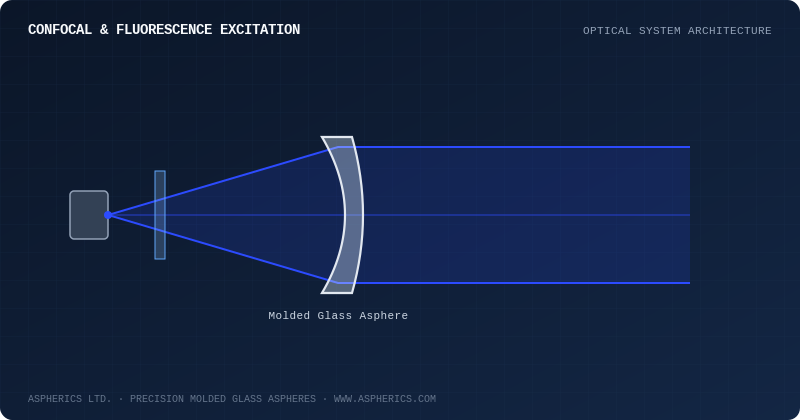
Lasers are usually combined and coupled into one single-mode fiber, which delivers a clean Gaussian mode to the scan head. The collimator turns the fiber output (NA about 0.1) into a beam of about 2 × EFL × NA: a 15 mm lens gives roughly 3 mm. Because the fiber carries several lines, the collimator should focus them all at the same distance, or the spots separate axially at the sample.
<p>The fiber output is collimated by an asphere and expanded to the objective aperture. For several lines through one fiber, choose a design whose focus shift across the lines is small, shown on each lens page, or compensate it with the expander.</p><p>Direct diode excitation in compact readers uses one collimator per diode, often as a pre-aligned laser diode module.</p>

Key Advantages
- Long visible focal lengths. 10 to 22 mm designs for fiber collimation at 520 to 650 nm.
- Chromatic data per lens. Focus shift across the coating band is plotted for every design.
- Broadband coatings. BBAR-VIS across 400–700 nm for multi-line fibers.
- Aligned diode sources. Modules for compact readers.
Recommended Catalogue Parts
Molded Glass Aspheric Lenses
| Part Number | DWL | EFL | NA | Engineering Fit | Action |
|---|---|---|---|---|---|
| AL-D0800-F2258-W532 | 532 nm | 22.58 mm | 0.15 | 532 nm, Ø8 mm, EFL 22.58 mm, NA 0.15: collimates NA 0.1 single-mode fiber output to about 4.5 mm. | |
| AL-D1050-F1526-W639 | 639 nm | 15.26 mm | 0.3 | 639 nm, Ø10.5 mm, EFL 15.26 mm, NA 0.3: collimates NA 0.1 single-mode fiber output to about 3.1 mm. | |
| AL-D0650-F1206-W635 | 635 nm | 12.06 mm | 0.22 | 635 nm, Ø6.5 mm, EFL 12.06 mm, NA 0.22: collimates NA 0.1 single-mode fiber output to about 2.4 mm. | |
| AL-D0800-F1118-W635 | 635 nm | 11.18 mm | 0.31 | 635 nm, Ø8 mm, EFL 11.18 mm, NA 0.31: collimates NA 0.1 single-mode fiber output to about 2.2 mm. | |
| AL-D0720-F1099-W633 | 633 nm | 10.99 mm | 0.28 | 633 nm, Ø7.2 mm, EFL 10.99 mm, NA 0.28: collimates NA 0.1 single-mode fiber output to about 2.2 mm. | |
| AL-D0635-F1000-W520 | 520 nm | 10 mm | 0.275 | 520 nm, Ø6.35 mm, EFL 10 mm, NA 0.275: collimates NA 0.1 single-mode fiber output to about 2.0 mm. | |
| AL-D06325-F1385-W650 | 650 nm | 13.85 mm | 0.18 | 650 nm, Ø6.325 mm, EFL 13.85 mm, NA 0.18: collimates NA 0.1 single-mode fiber output to about 2.8 mm. | |
| AL-D0400-F0400-W405 | 405 nm | 4 mm | 0.4 | 405 nm, Ø4 mm, EFL 4 mm, NA 0.4: direct diode excitation, 3.2 mm beam. | |
| AL-D0300-F0320-W633 | 633 nm | 3.2 mm | 0.37 | 633 nm, Ø3 mm, EFL 3.2 mm, NA 0.37: direct diode excitation, 2.4 mm beam. | |
| AL-D0150-F0185-W515 | 515 nm | 1.85 mm | 0.32 | 515 nm, Ø1.5 mm, EFL 1.85 mm, NA 0.32: direct diode excitation, 1.2 mm beam. | |
| AL-D0633-F0405-W445 | 445 nm | 4.05 mm | 0.63 | 445 nm, Ø6.33 mm, EFL 4.05 mm, NA 0.63: direct diode excitation, 5.1 mm beam. | |
| AL-D06325-F0402-W408 | 408 nm | 4.02 mm | 0.6 | 408 nm, Ø6.325 mm, EFL 4.02 mm, NA 0.6: direct diode excitation, 4.8 mm beam. | |
| AL-D1500-F1124-W587 | 587 nm | 11.24 mm | 0.62 |
Mounted Aspheric Lenses
| Part Number | DWL | EFL | NA | Engineering Fit | Action |
|---|---|---|---|---|---|
| MAB-D0800-F2258-W532 | 532 nm | 22.58 mm | 0.15 | AL-D0800-F2258-W532 in a M12 / M11 / M9 ×0.5 barrel, 14 configurations: screw into the diode socket and focus by rotation. | |
| MAB-D1050-F1526-W639 | 639 nm | 15.26 mm | 0.3 | AL-D1050-F1526-W639 in a M14 / M12 ×0.5 barrel, 9 configurations: screw into the diode socket and focus by rotation. | |
| MAB-D0650-F1206-W635 | 635 nm | 12.06 mm | 0.22 | AL-D0650-F1206-W635 in a M12 / M10 / M9 ×0.5 barrel, 14 configurations: screw into the diode socket and focus by rotation. | |
| MAB-D0800-F1118-W635 | 635 nm | 11.18 mm | 0.31 | AL-D0800-F1118-W635 in a M12 / M11 / M9 ×0.5 barrel, 14 configurations: screw into the diode socket and focus by rotation. | |
| MAB-D0720-F1099-W633 | 633 nm | 10.99 mm | 0.28 | AL-D0720-F1099-W633 in a M12 / M10 / M9 ×0.5 barrel, 13 configurations: screw into the diode socket and focus by rotation. | |
| MAB-D0635-F1000-W520 | 520 nm | 10 mm | 0.275 | AL-D0635-F1000-W520 in a M12 / M10 / M9 ×0.5 barrel, 14 configurations: screw into the diode socket and focus by rotation. | |
| MAB-D06325-F1385-W650 | 650 nm | 13.85 mm | 0.18 | AL-D06325-F1385-W650 in a M12 / M10 / M9 ×0.5 barrel, 14 configurations: screw into the diode socket and focus by rotation. | |
| MAB-D0400-F0400-W405 | 405 nm | 4 mm | 0.4 | AL-D0400-F0400-W405 in a M12 / M9 / M7 ×0.5 barrel, 12 configurations: screw into the diode socket and focus by rotation. |
Laser Diode Modules
| Part Number | DWL | EFL | NA | Engineering Fit | Action |
|---|---|---|---|---|---|
| LDM-D0800-F2258-W532 | 532 nm | 22.58 mm | 0.15 | 532 nm diode aligned to AL-D0800-F2258-W532: Ø5.6 / Ø9 mm can, laser welded or uv epoxy, pointing ≤ 1 mrad. | |
| LDM-D1050-F1526-W639 | 639 nm | 15.26 mm | 0.3 | 639 nm diode aligned to AL-D1050-F1526-W639: Ø5.6 / Ø9 mm can, laser welded or uv epoxy, pointing ≤ 1 mrad. | |
| LDM-D0650-F1206-W635 | 635 nm | 12.06 mm | 0.22 | 635 nm diode aligned to AL-D0650-F1206-W635: Ø5.6 / Ø9 mm can, laser welded or uv epoxy, pointing ≤ 1 mrad. | |
| LDM-D0800-F1118-W635 | 635 nm | 11.18 mm | 0.31 | 635 nm diode aligned to AL-D0800-F1118-W635: Ø5.6 / Ø9 mm can, laser welded or uv epoxy, pointing ≤ 1 mrad. | |
| LDM-D0720-F1099-W633 | 633 nm | 10.99 mm | 0.28 | 633 nm diode aligned to AL-D0720-F1099-W633: Ø5.6 / Ø9 mm can, laser welded or uv epoxy, pointing ≤ 1 mrad. | |
| LDM-D0635-F1000-W520 | 520 nm | 10 mm | 0.275 | 520 nm diode aligned to AL-D0635-F1000-W520: Ø5.6 / Ø9 mm can, laser welded or uv epoxy, pointing ≤ 1 mrad. | |
| LDM-D06325-F1385-W650 | 650 nm | 13.85 mm | 0.18 | 650 nm diode aligned to AL-D06325-F1385-W650: Ø5.6 / Ø9 mm can, laser welded or uv epoxy, pointing ≤ 1 mrad. | |
| LDM-D0400-F0400-W405 | 405 nm | 4 mm | 0.4 | 405 nm diode aligned to AL-D0400-F0400-W405: Ø3.8 / Ø5.6 mm can, laser welded or uv epoxy, pointing ≤ 1 mrad. |
Frequently Asked Questions
Can one collimator serve 405 to 640 nm?
Yes with BBAR-VIS, but the focus shifts with wavelength. The lens pages plot it; choose a design with a small shift across your lines or correct it in the beam expander.
Which focal length for my objective?
Beam ≈ 2 × EFL × fiber NA; then expand to the back aperture. A 15 mm lens on a 0.1 NA fiber gives about 3 mm before expansion.
Is stress birefringence an issue?
Molded glass has specified stress birefringence (typically 10 nm/cm); for polarisation-sensitive paths, ask for the value of the lens you choose.
Related Applications
High-NA aspheres for diode-to-fiber coupling, fiber collimators and 915 / 976 nm pump optics.
Excitation collimators and collection optics for Raman and fluorescence spectrometers at 532, 785 and 830 nm.
Excitation optics for flow cytometers and bio-analytical instruments at 405, 445, 520 and 635 to 650 nm.