
Flow Cytometry & Bio-Analytical
Excitation optics for flow cytometers and bio-analytical instruments at 405, 445, 520 and 635 to 650 nm.
Optical Requirements & Rationale
The excitation spot
The sample stream is typically 10 to 50 µm wide. The laser is focused to an elliptical spot, narrow along the flow (about 10 µm) for time resolution and wide across it (50 to 100 µm) so that cells near the edge of the stream see nearly the same intensity as those in the centre. This is done with a collimator followed by crossed cylindrical lenses or a cylindrical-spherical pair.
Several lasers, one stream
Instruments use two to six lines, often 405, 488, 561 and 640 nm, at spatially separated spots along the stream. Each line has its own collimator; matching the collimated beam sizes keeps the downstream beam-shaping optics common to all channels.
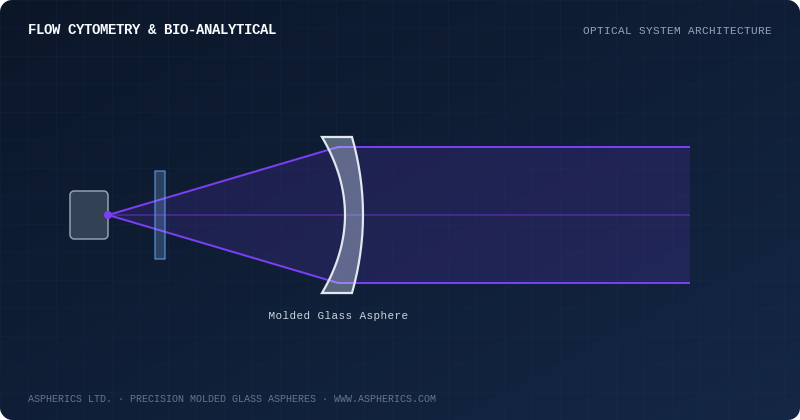
<p>Each diode is collimated by an asphere at its line, then shaped by cylindrical optics into the elliptical spot. The beams are combined or kept separate depending on whether the instrument uses collinear or spatially separated excitation.</p><p>A pre-aligned laser diode module for each line reduces the alignment to placing modules in bores; its pointing of ≤ 1 mrad to the body keeps the spots on the stream.</p>

Key Advantages
- Cytometry lines covered. Designs at 405, 408, 445, 520, 532 and 633 to 650 nm.
- Matched outlines. Ø3 mm and Ø6.35 mm lenses across colours share mounts.
- Violet and blue without adhesive. Laser-welded modules keep adhesive away from GaN diodes.
- Stable pointing. Modules hold pointing ≤ 1 mrad to their body axis.
Recommended Catalogue Parts
Molded Glass Aspheric Lenses
| Part Number | DWL | EFL | NA | Engineering Fit | Action |
|---|---|---|---|---|---|
| AL-D0300-F0320-W633 | 633 nm | 3.2 mm | 0.37 | 633 nm excitation line: 633 nm, Ø3 mm, EFL 3.2 mm, NA 0.37, 2.4 mm beam before the beam-shaping optics. | |
| AL-D0300-F0376-W635 | 635 nm | 3.76 mm | 0.33 | 635 nm excitation line: 635 nm, Ø3 mm, EFL 3.76 mm, NA 0.33, 2.5 mm beam before the beam-shaping optics. | |
| AL-D0635-F1000-W520 | 520 nm | 10 mm | 0.275 | 520 nm excitation line: 520 nm, Ø6.35 mm, EFL 10 mm, NA 0.275, 5.5 mm beam before the beam-shaping optics. | |
| AL-D0300-F0450-W633 | 633 nm | 4.5 mm | 0.3 | 633 nm excitation line: 633 nm, Ø3 mm, EFL 4.5 mm, NA 0.3, 2.7 mm beam before the beam-shaping optics. | |
| AL-D0300-F0600-W635 | 635 nm | 6 mm | 0.21 | 635 nm excitation line: 635 nm, Ø3 mm, EFL 6 mm, NA 0.21, 2.5 mm beam before the beam-shaping optics. | |
| AL-D0400-F0400-W405 | 405 nm | 4 mm | 0.4 | 405 nm excitation line: 405 nm, Ø4 mm, EFL 4 mm, NA 0.4, 3.2 mm beam before the beam-shaping optics. | |
| AL-D06325-F1385-W650 | 650 nm | 13.85 mm | 0.18 | 650 nm excitation line: 650 nm, Ø6.325 mm, EFL 13.85 mm, NA 0.18, 5.0 mm beam before the beam-shaping optics. | |
| AL-D1050-F1526-W639 | 639 nm | 15.26 mm | 0.3 | 639 nm excitation line: 639 nm, Ø10.5 mm, EFL 15.26 mm, NA 0.3, 9.2 mm beam before the beam-shaping optics. | |
| AL-D0800-F2258-W532 | 532 nm | 22.58 mm | 0.15 | 532 nm excitation line: 532 nm, Ø8 mm, EFL 22.58 mm, NA 0.15, 6.8 mm beam before the beam-shaping optics. | |
| AL-D06325-F0402-W408 | 408 nm | 4.02 mm | 0.6 | 408 nm excitation line: 408 nm, Ø6.325 mm, EFL 4.02 mm, NA 0.6, 4.8 mm beam before the beam-shaping optics. | |
| AL-D0150-F0185-W515 | 515 nm | 1.85 mm | 0.32 | 515 nm excitation line: 515 nm, Ø1.5 mm, EFL 1.85 mm, NA 0.32, 1.2 mm beam before the beam-shaping optics. | |
| AL-D0633-F0405-W445 | 445 nm | 4.05 mm | 0.63 | 445 nm excitation line: 445 nm, Ø6.33 mm, EFL 4.05 mm, NA 0.63, 5.1 mm beam before the beam-shaping optics. | |
| AL-D1500-F1124-W587 | 587 nm | 11.24 mm | 0.62 |
Mounted Aspheric Lenses
| Part Number | DWL | EFL | NA | Engineering Fit | Action |
|---|---|---|---|---|---|
| MAB-D0300-F0320-W633 | 633 nm | 3.2 mm | 0.37 | AL-D0300-F0320-W633 in a M12 / M9 / M7 ×0.5 barrel, 12 configurations: screw into the diode socket and focus by rotation. | |
| MAB-D0300-F0376-W635 | 635 nm | 3.76 mm | 0.33 | AL-D0300-F0376-W635 in a M12 / M9 / M7 ×0.5 barrel, 12 configurations: screw into the diode socket and focus by rotation. | |
| MAB-D0635-F1000-W520 | 520 nm | 10 mm | 0.275 | AL-D0635-F1000-W520 in a M12 / M10 / M9 ×0.5 barrel, 14 configurations: screw into the diode socket and focus by rotation. | |
| MAB-D0300-F0450-W633 | 633 nm | 4.5 mm | 0.3 | AL-D0300-F0450-W633 in a M12 / M9 / M6 ×0.5 barrel, 12 configurations: screw into the diode socket and focus by rotation. | |
| MAB-D0300-F0600-W635 | 635 nm | 6 mm | 0.21 | AL-D0300-F0600-W635 in a M12 / M9 / M6 ×0.5 barrel, 12 configurations: screw into the diode socket and focus by rotation. | |
| MAB-D0400-F0400-W405 | 405 nm | 4 mm | 0.4 | AL-D0400-F0400-W405 in a M12 / M9 / M7 ×0.5 barrel, 12 configurations: screw into the diode socket and focus by rotation. | |
| MAB-D06325-F1385-W650 | 650 nm | 13.85 mm | 0.18 | AL-D06325-F1385-W650 in a M12 / M10 / M9 ×0.5 barrel, 14 configurations: screw into the diode socket and focus by rotation. | |
| MAB-D1050-F1526-W639 | 639 nm | 15.26 mm | 0.3 | AL-D1050-F1526-W639 in a M14 / M12 ×0.5 barrel, 9 configurations: screw into the diode socket and focus by rotation. |
Laser Diode Modules
| Part Number | DWL | EFL | NA | Engineering Fit | Action |
|---|---|---|---|---|---|
| LDM-D0300-F0320-W633 | 633 nm | 3.2 mm | 0.37 | 633 nm diode aligned to AL-D0300-F0320-W633: Ø3.8 / Ø5.6 mm can, laser welded or uv epoxy, pointing ≤ 1 mrad. | |
| LDM-D0300-F0376-W635 | 635 nm | 3.76 mm | 0.33 | 635 nm diode aligned to AL-D0300-F0376-W635: Ø3.8 / Ø5.6 mm can, laser welded or uv epoxy, pointing ≤ 1 mrad. | |
| LDM-D0635-F1000-W520 | 520 nm | 10 mm | 0.275 | 520 nm diode aligned to AL-D0635-F1000-W520: Ø5.6 / Ø9 mm can, laser welded or uv epoxy, pointing ≤ 1 mrad. | |
| LDM-D0300-F0450-W633 | 633 nm | 4.5 mm | 0.3 | 633 nm diode aligned to AL-D0300-F0450-W633: Ø3.8 / Ø5.6 mm can, laser welded or uv epoxy, pointing ≤ 1 mrad. | |
| LDM-D0300-F0600-W635 | 635 nm | 6 mm | 0.21 | 635 nm diode aligned to AL-D0300-F0600-W635: Ø3.8 / Ø5.6 mm can, laser welded or uv epoxy, pointing ≤ 1 mrad. | |
| LDM-D0400-F0400-W405 | 405 nm | 4 mm | 0.4 | 405 nm diode aligned to AL-D0400-F0400-W405: Ø3.8 / Ø5.6 mm can, laser welded or uv epoxy, pointing ≤ 1 mrad. | |
| LDM-D06325-F1385-W650 | 650 nm | 13.85 mm | 0.18 | 650 nm diode aligned to AL-D06325-F1385-W650: Ø5.6 / Ø9 mm can, laser welded or uv epoxy, pointing ≤ 1 mrad. | |
| LDM-D1050-F1526-W639 | 639 nm | 15.26 mm | 0.3 | 639 nm diode aligned to AL-D1050-F1526-W639: Ø5.6 / Ø9 mm can, laser welded or uv epoxy, pointing ≤ 1 mrad. |
Frequently Asked Questions
Why are 488 and 561 nm not listed as design wavelengths?
They lie inside the visible coating band; the 445 nm and 520 / 532 nm designs refocus to them, as plotted on each lens page. Coatings are centred on your line.
Can I get aligned excitation sources?
Yes: laser diode modules at the visible lines, aligned and measured for pointing. For violet and blue, the laser-welded version is standard.
Do you make the cylindrical optics?
Our catalogue is rotationally symmetric aspheres; we quote anamorphic optics as custom parts.
Related Applications
Collimators for red, green and blue diodes in pico-projectors, head-up displays and laser light engines.
Excitation collimators and collection optics for Raman and fluorescence spectrometers at 532, 785 and 830 nm.
Collimators for fiber-delivered and free-space excitation lasers in confocal and fluorescence instruments.
Laser sources for optical particle counters, air-quality sensors and aspirating smoke detectors.