
Particle Counting & Smoke Detection
Laser sources for optical particle counters, air-quality sensors and aspirating smoke detectors.
Optical Requirements & Rationale
Scattering and size
A particle crossing the beam scatters light in proportion to its size, refractive index and the wavelength; a photodiode at an angle to the beam sees a pulse whose height indicates particle size. Shorter wavelengths scatter more from small particles: 405 to 450 nm sensors detect smaller particles than 650 to 780 nm ones.
Stray light is the noise floor
Any light scattered by the optics or chamber walls reaches the detector as a constant background that hides small particles. A clean, well-collimated beam, a beam dump opposite the source and apertures before the chamber keep that background down. The collimator's surface quality and coating directly affect the detection limit.
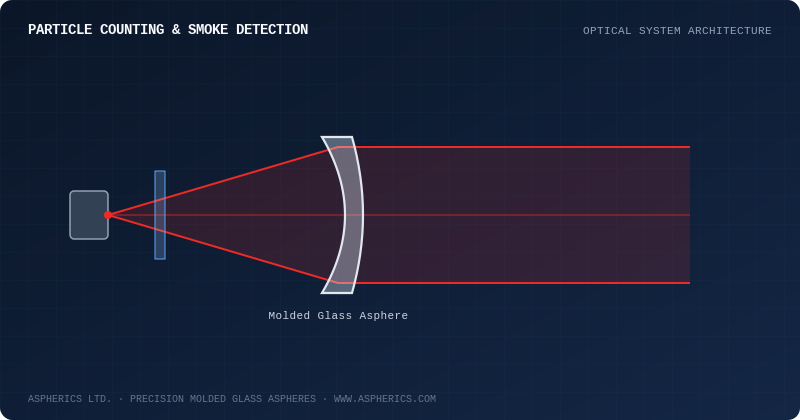
<p>The diode is collimated or focused into a ribbon across the air flow, sometimes with a cylindrical lens; a light trap absorbs the beam after the chamber. The detector views the crossing at 45° to 90°, with a collection lens or mirror.</p><p>A pre-aligned laser diode module simplifies the chamber: its body sits in a bore that defines the beam axis, so the beam reaches the light trap without adjustment.</p>

Key Advantages
- Violet to NIR. Designs from 405 to 830 nm for different particle-size ranges.
- Low stray light. Glass lenses with NBAR coatings, R < 0.5 % per surface.
- Axis by mechanics. Module pointing ≤ 1 mrad to the body: the beam hits the light trap.
- Long life. Welded modules avoid adhesive contamination of the diode.
Recommended Catalogue Parts
Molded Glass Aspheric Lenses
| Part Number | DWL | EFL | NA | Engineering Fit | Action |
|---|---|---|---|---|---|
| AL-D0300-F0200-W780 | 780 nm | 2 mm | 0.5 | 780 nm, Ø3 mm, EFL 2 mm, NA 0.5: infrared scattering source. | |
| AL-D0300-F0320-W633 | 633 nm | 3.2 mm | 0.37 | 633 nm, Ø3 mm, EFL 3.2 mm, NA 0.37: PM / smoke scattering source. | |
| AL-D0300-F0376-W635 | 635 nm | 3.76 mm | 0.33 | 635 nm, Ø3 mm, EFL 3.76 mm, NA 0.33: PM / smoke scattering source. | |
| AL-D0400-F0400-W405 | 405 nm | 4 mm | 0.4 | 405 nm, Ø4 mm, EFL 4 mm, NA 0.4: small-particle scattering source. | |
| AL-D0470-F0616-W780 | 780 nm | 6.16 mm | 0.3 | 780 nm, Ø4.7 mm, EFL 6.16 mm, NA 0.3: infrared scattering source. | |
| AL-D0300-F0450-W633 | 633 nm | 4.5 mm | 0.3 | 633 nm, Ø3 mm, EFL 4.5 mm, NA 0.3: PM / smoke scattering source. | |
| AL-D1050-F1526-W639 | 639 nm | 15.26 mm | 0.3 | 639 nm, Ø10.5 mm, EFL 15.26 mm, NA 0.3: PM / smoke scattering source. | |
| AL-D0950-F2406-W785 | 785 nm | 24.06 mm | 0.16 | 785 nm, Ø9.5 mm, EFL 24.06 mm, NA 0.16: infrared scattering source. | |
| AL-D0635-F0643-W830 | 830 nm | 6.43 mm | 0.43 | 830 nm, Ø6.35 mm, EFL 6.43 mm, NA 0.43: infrared scattering source. | |
| AL-D06325-F1385-W650 | 650 nm | 13.85 mm | 0.18 | 650 nm, Ø6.325 mm, EFL 13.85 mm, NA 0.18: PM / smoke scattering source. | |
| AL-D0633-F0405-W445 | 445 nm | 4.05 mm | 0.63 | 445 nm, Ø6.33 mm, EFL 4.05 mm, NA 0.63: small-particle scattering source. | |
| AL-D06325-F0402-W408 | 408 nm | 4.02 mm | 0.6 | 408 nm, Ø6.325 mm, EFL 4.02 mm, NA 0.6: small-particle scattering source. |
Mounted Aspheric Lenses
| Part Number | DWL | EFL | NA | Engineering Fit | Action |
|---|---|---|---|---|---|
| MAB-D0300-F0200-W780 | 780 nm | 2 mm | 0.5 | AL-D0300-F0200-W780 in a M12 / M9 / M7 ×0.5 barrel, 12 configurations: screw into the diode socket and focus by rotation. | |
| MAB-D0300-F0320-W633 | 633 nm | 3.2 mm | 0.37 | AL-D0300-F0320-W633 in a M12 / M9 / M7 ×0.5 barrel, 12 configurations: screw into the diode socket and focus by rotation. | |
| MAB-D0300-F0376-W635 | 635 nm | 3.76 mm | 0.33 | AL-D0300-F0376-W635 in a M12 / M9 / M7 ×0.5 barrel, 12 configurations: screw into the diode socket and focus by rotation. | |
| MAB-D0400-F0400-W405 | 405 nm | 4 mm | 0.4 | AL-D0400-F0400-W405 in a M12 / M9 / M7 ×0.5 barrel, 12 configurations: screw into the diode socket and focus by rotation. | |
| MAB-D0470-F0616-W780 | 780 nm | 6.16 mm | 0.3 | AL-D0470-F0616-W780 in a M12 / M9 / M8 ×0.5 barrel, 14 configurations: screw into the diode socket and focus by rotation. | |
| MAB-D0300-F0450-W633 | 633 nm | 4.5 mm | 0.3 | AL-D0300-F0450-W633 in a M12 / M9 / M6 ×0.5 barrel, 12 configurations: screw into the diode socket and focus by rotation. | |
| MAB-D1050-F1526-W639 | 639 nm | 15.26 mm | 0.3 | AL-D1050-F1526-W639 in a M14 / M12 ×0.5 barrel, 9 configurations: screw into the diode socket and focus by rotation. | |
| MAB-D0950-F2406-W785 | 785 nm | 24.06 mm | 0.16 | AL-D0950-F2406-W785 in a M14 / M12 ×0.5 barrel, 9 configurations: screw into the diode socket and focus by rotation. |
Laser Diode Modules
| Part Number | DWL | EFL | NA | Engineering Fit | Action |
|---|---|---|---|---|---|
| LDM-D0300-F0200-W780 | 780 nm | 2 mm | 0.5 | 780 nm diode aligned to AL-D0300-F0200-W780: Ø5.6 mm can, laser welded or uv epoxy, pointing ≤ 1 mrad. | |
| LDM-D0300-F0320-W633 | 633 nm | 3.2 mm | 0.37 | 633 nm diode aligned to AL-D0300-F0320-W633: Ø3.8 / Ø5.6 mm can, laser welded or uv epoxy, pointing ≤ 1 mrad. | |
| LDM-D0300-F0376-W635 | 635 nm | 3.76 mm | 0.33 | 635 nm diode aligned to AL-D0300-F0376-W635: Ø3.8 / Ø5.6 mm can, laser welded or uv epoxy, pointing ≤ 1 mrad. | |
| LDM-D0400-F0400-W405 | 405 nm | 4 mm | 0.4 | 405 nm diode aligned to AL-D0400-F0400-W405: Ø3.8 / Ø5.6 mm can, laser welded or uv epoxy, pointing ≤ 1 mrad. | |
| LDM-D0470-F0616-W780 | 780 nm | 6.16 mm | 0.3 | 780 nm diode aligned to AL-D0470-F0616-W780: Ø5.6 / Ø9 mm can, laser welded or uv epoxy, pointing ≤ 1 mrad. | |
| LDM-D0300-F0450-W633 | 633 nm | 4.5 mm | 0.3 | 633 nm diode aligned to AL-D0300-F0450-W633: Ø3.8 / Ø5.6 mm can, laser welded or uv epoxy, pointing ≤ 1 mrad. | |
| LDM-D1050-F1526-W639 | 639 nm | 15.26 mm | 0.3 | 639 nm diode aligned to AL-D1050-F1526-W639: Ø5.6 / Ø9 mm can, laser welded or uv epoxy, pointing ≤ 1 mrad. | |
| LDM-D0950-F2406-W785 | 785 nm | 24.06 mm | 0.16 | 785 nm diode aligned to AL-D0950-F2406-W785: Ø5.6 / Ø9 mm can, laser welded or uv epoxy, pointing ≤ 1 mrad. |
Frequently Asked Questions
Which wavelength for PM2.5?
Red 635 to 650 nm sources are standard in low-cost PM sensors; violet sources extend detection to smaller particles in counters.
How do I keep stray light down?
Use a clean collimated beam with coated optics, apertures before the chamber and a light trap after it; a pre-aligned module keeps the beam on the trap.
Do modules include the driver?
No. Modules are the diode and lens aligned in one body; use your own current source.
Related Applications
Molded glass aspheres that turn a diode's divergent output into a clean, round-ish collimated beam, 405 to 1550 nm.
Red and NIR diode collimators for handheld scanners, fixed-mount readers and sorting systems.
Excitation optics for flow cytometers and bio-analytical instruments at 405, 445, 520 and 635 to 650 nm.