
Barcode Scanning & Industrial Readers
Red and NIR diode collimators for handheld scanners, fixed-mount readers and sorting systems.
Optical Requirements & Rationale
Spot size over depth
The scanner resolves a bar only if the laser spot is narrower than the bar along the scan direction. A tightly focused spot resolves fine codes but grows quickly outside its waist; a larger, slowly converging beam keeps an acceptable size over a deeper range. Scanners therefore use low NA and focus the beam slightly beyond collimation, so that the waist falls in the middle of the reading range.
Why an asphere
At these low NAs the lens is simple, but it must be small, stable and repeatable in production. A molded glass asphere gives the same working distance part after part, survives the thermal and mechanical shocks of a handheld device and holds its focal length over temperature.
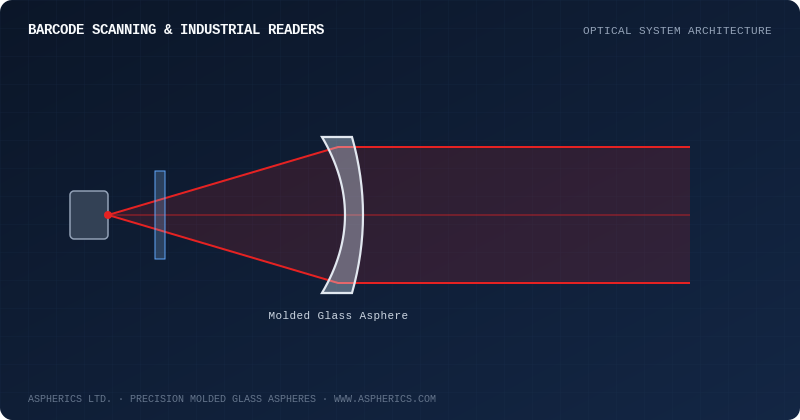
<p>A red diode in a Ø3.8 or Ø5.6 mm can sits behind a Ø3 mm asphere; the beam is set slightly converging so its waist lies in the working range. A polygon or MEMS mirror sweeps the beam across the code, and a separate collection lens focuses the diffuse return onto a photodiode.</p><p>In production, either the lens is focused in a threaded barrel and locked, or a pre-aligned laser diode module is used, so that every scanner leaves the line with the same spot.</p>

Key Advantages
- Red and NIR lines. 633, 635, 639, 650 nm and 780 / 785 nm designs.
- Compact barrels. M5 to M9 compact barrels and the standard M9 thread for scanner engines.
- Repeatable focus. Molded glass and ±1 % EFL keep the working distance consistent across production.
- Pre-aligned option. Modules remove the focusing step from your line.
Recommended Catalogue Parts
Molded Glass Aspheric Lenses
| Part Number | DWL | EFL | NA | Engineering Fit | Action |
|---|---|---|---|---|---|
| AL-D0300-F0320-W633 | 633 nm | 3.2 mm | 0.37 | 633 nm, Ø3 mm, EFL 3.2 mm, NA 0.37: low-NA 633 nm scanner source, 2.4 mm beam, fits compact barrels. | |
| AL-D0300-F0376-W635 | 635 nm | 3.76 mm | 0.33 | 635 nm, Ø3 mm, EFL 3.76 mm, NA 0.33: low-NA 635 nm scanner source, 2.5 mm beam, fits compact barrels. | |
| AL-D0300-F0450-W633 | 633 nm | 4.5 mm | 0.3 | 633 nm, Ø3 mm, EFL 4.5 mm, NA 0.3: low-NA 633 nm scanner source, 2.7 mm beam, fits compact barrels. | |
| AL-D0300-F0600-W635 | 635 nm | 6 mm | 0.21 | 635 nm, Ø3 mm, EFL 6 mm, NA 0.21: low-NA 635 nm scanner source, 2.5 mm beam, fits compact barrels. | |
| AL-D0300-F0470-W633 | 633 nm | 4.7 mm | 0.25 | 633 nm, Ø3 mm, EFL 4.7 mm, NA 0.25: low-NA 633 nm scanner source, 2.4 mm beam, fits compact barrels. | |
| AL-D0470-F0616-W780 | 780 nm | 6.16 mm | 0.3 | 780 nm, Ø4.7 mm, EFL 6.16 mm, NA 0.3: low-NA 780 nm scanner source, 3.7 mm beam. | |
| AL-D1050-F1526-W639 | 639 nm | 15.26 mm | 0.3 | 639 nm, Ø10.5 mm, EFL 15.26 mm, NA 0.3: low-NA 639 nm scanner source, 9.2 mm beam. | |
| AL-D0950-F2406-W785 | 785 nm | 24.06 mm | 0.16 | 785 nm, Ø9.5 mm, EFL 24.06 mm, NA 0.16: low-NA 785 nm scanner source, 7.7 mm beam. | |
| AL-D0720-F0624-W780 | 780 nm | 6.24 mm | 0.4 | 780 nm, Ø7.2 mm, EFL 6.24 mm, NA 0.4: low-NA 780 nm scanner source, 5.0 mm beam. | |
| AL-D0930-F3199-W785 | 785 nm | 31.99 mm | 0.122 | 785 nm, Ø9.3 mm, EFL 31.99 mm, NA 0.122: low-NA 785 nm scanner source, 7.8 mm beam. | |
| AL-D0800-F0842-W635 | 635 nm | 8.42 mm | 0.37 | 635 nm, Ø8 mm, EFL 8.42 mm, NA 0.37: low-NA 635 nm scanner source, 6.2 mm beam. | |
| AL-D06325-F1385-W650 | 650 nm | 13.85 mm | 0.18 | 650 nm, Ø6.325 mm, EFL 13.85 mm, NA 0.18: low-NA 650 nm scanner source, 5.0 mm beam. |
Mounted Aspheric Lenses
| Part Number | DWL | EFL | NA | Engineering Fit | Action |
|---|---|---|---|---|---|
| MAB-D0300-F0320-W633 | 633 nm | 3.2 mm | 0.37 | AL-D0300-F0320-W633 in a M12 / M9 / M7 ×0.5 barrel, 12 configurations: screw into the diode socket and focus by rotation. | |
| MAB-D0300-F0376-W635 | 635 nm | 3.76 mm | 0.33 | AL-D0300-F0376-W635 in a M12 / M9 / M7 ×0.5 barrel, 12 configurations: screw into the diode socket and focus by rotation. | |
| MAB-D0300-F0450-W633 | 633 nm | 4.5 mm | 0.3 | AL-D0300-F0450-W633 in a M12 / M9 / M6 ×0.5 barrel, 12 configurations: screw into the diode socket and focus by rotation. | |
| MAB-D0300-F0600-W635 | 635 nm | 6 mm | 0.21 | AL-D0300-F0600-W635 in a M12 / M9 / M6 ×0.5 barrel, 12 configurations: screw into the diode socket and focus by rotation. | |
| MAB-D0300-F0470-W633 | 633 nm | 4.7 mm | 0.25 | AL-D0300-F0470-W633 in a M12 / M9 / M6 ×0.5 barrel, 12 configurations: screw into the diode socket and focus by rotation. | |
| MAB-D0470-F0616-W780 | 780 nm | 6.16 mm | 0.3 | AL-D0470-F0616-W780 in a M12 / M9 / M8 ×0.5 barrel, 14 configurations: screw into the diode socket and focus by rotation. | |
| MAB-D1050-F1526-W639 | 639 nm | 15.26 mm | 0.3 | AL-D1050-F1526-W639 in a M14 / M12 ×0.5 barrel, 9 configurations: screw into the diode socket and focus by rotation. | |
| MAB-D0950-F2406-W785 | 785 nm | 24.06 mm | 0.16 | AL-D0950-F2406-W785 in a M14 / M12 ×0.5 barrel, 9 configurations: screw into the diode socket and focus by rotation. |
Laser Diode Modules
| Part Number | DWL | EFL | NA | Engineering Fit | Action |
|---|---|---|---|---|---|
| LDM-D0300-F0320-W633 | 633 nm | 3.2 mm | 0.37 | 633 nm diode aligned to AL-D0300-F0320-W633: Ø3.8 / Ø5.6 mm can, laser welded or uv epoxy, pointing ≤ 1 mrad. | |
| LDM-D0300-F0376-W635 | 635 nm | 3.76 mm | 0.33 | 635 nm diode aligned to AL-D0300-F0376-W635: Ø3.8 / Ø5.6 mm can, laser welded or uv epoxy, pointing ≤ 1 mrad. | |
| LDM-D0300-F0450-W633 | 633 nm | 4.5 mm | 0.3 | 633 nm diode aligned to AL-D0300-F0450-W633: Ø3.8 / Ø5.6 mm can, laser welded or uv epoxy, pointing ≤ 1 mrad. | |
| LDM-D0300-F0600-W635 | 635 nm | 6 mm | 0.21 | 635 nm diode aligned to AL-D0300-F0600-W635: Ø3.8 / Ø5.6 mm can, laser welded or uv epoxy, pointing ≤ 1 mrad. | |
| LDM-D0300-F0470-W633 | 633 nm | 4.7 mm | 0.25 | 633 nm diode aligned to AL-D0300-F0470-W633: Ø3.8 / Ø5.6 mm can, laser welded or uv epoxy, pointing ≤ 1 mrad. | |
| LDM-D0470-F0616-W780 | 780 nm | 6.16 mm | 0.3 | 780 nm diode aligned to AL-D0470-F0616-W780: Ø5.6 / Ø9 mm can, laser welded or uv epoxy, pointing ≤ 1 mrad. | |
| LDM-D1050-F1526-W639 | 639 nm | 15.26 mm | 0.3 | 639 nm diode aligned to AL-D1050-F1526-W639: Ø5.6 / Ø9 mm can, laser welded or uv epoxy, pointing ≤ 1 mrad. | |
| LDM-D0950-F2406-W785 | 785 nm | 24.06 mm | 0.16 | 785 nm diode aligned to AL-D0950-F2406-W785: Ø5.6 / Ø9 mm can, laser welded or uv epoxy, pointing ≤ 1 mrad. |
Frequently Asked Questions
Should the beam be collimated or focused?
Usually slightly focused, with the waist in the middle of the reading range. Collimation gives the largest depth at the cost of spot size; tighter focus resolves finer codes over a shorter range.
Which wavelength is best?
Red at 635 to 650 nm is the standard: visible for aiming and well read by silicon detectors. 780 nm is used for infrared-readable codes.
Can you supply the diode and lens aligned?
Yes. Our laser diode modules come with the lens aligned on the live beam and fixed; we can set the focus to your reading distance on request.
Related Applications
Molded glass aspheres that turn a diode's divergent output into a clean, round-ish collimated beam, 405 to 1550 nm.
Transmit collimators and receive lenses for laser rangefinders, ToF and LiDAR sensors at 780 to 1550 nm.
Dot and line projectors for triangulation sensors, 3D profilers and structured-light vision.
Laser sources for optical particle counters, air-quality sensors and aspirating smoke detectors.