
Laser Projection & RGB Display
Collimators for red, green and blue diodes in pico-projectors, head-up displays and laser light engines.
Optical Requirements & Rationale
Three sources, one pixel
In a scanned-beam display the three colours share one scanning mirror; any difference between the beams shows up on the screen. A difference in beam size changes the pixel size per colour, a difference in divergence changes it with distance, and a difference in pointing shifts the colours apart. The collimators set all three.
What decides the match
Beam diameter is about 2 × EFL × NA; the NA that matters is the diode's own, so different diodes behind the same lens can give different beam sizes. Divergence is set by the emitter width over EFL and by diffraction; pointing is set by the emitter position. Choosing lenses with the same or proportional focal lengths at each wavelength, and aligning each channel on its live beam, keeps the three beams together.
Why molded glass
Green and blue GaN diodes run warm and at high radiance; glass lenses keep focal length stable with temperature and do not degrade under blue light the way many plastics do.
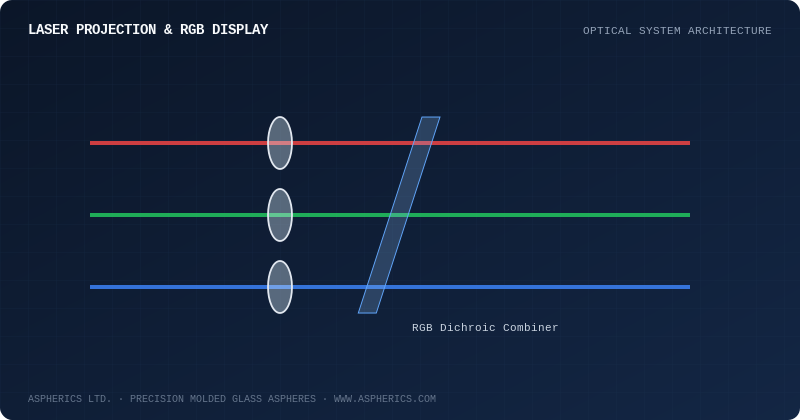
<p>Each diode is collimated by its own asphere; dichroic mirrors combine the three beams onto the scanner (MEMS mirror) or the modulator. Each channel is aligned so that its beam is coaxial with the others at the combiner, then fixed. Where the beams must also be round, an anamorphic prism pair or cylindrical lens follows each collimator.</p><p>Matched pairs exist in the catalogue: AL-D0635-F1000-W520 and AL-D0635-F1000-W635 share a Ø6.35 mm outline and a 10 mm focal length for green and red, and the Ø3 mm green and red designs suit compact engines. Blue at 445 nm is covered by AL-D0633-F0405-W445 for plastic-cap diodes and by the 405 / 408 nm designs, which refocus for 440 to 460 nm within their coating band.</p>

Key Advantages
- Display lines covered. Designs at 445, 520, 532 and 633 to 650 nm, with NBAR coatings per channel (R < 0.5 % per surface).
- Matched outlines. Ø3 mm and Ø6.35 mm families let one mechanical design hold all channels.
- Aligned channels to order. Laser diode modules fix each diode to its lens with pointing ≤ 1 mrad to the body axis, so channels register by mechanics.
- Glass under blue light. Molded glass keeps transmission and focal length stable with GaN diodes.
Recommended Catalogue Parts
Molded Glass Aspheric Lenses
| Part Number | DWL | EFL | NA | Engineering Fit | Action |
|---|---|---|---|---|---|
| AL-D0300-F0320-W633 | 633 nm | 3.2 mm | 0.37 | Red channel: 633 nm, Ø3 mm, EFL 3.2 mm, NA 0.37, 2.4 mm beam; NBAR-RED per channel. | |
| AL-D0300-F0376-W635 | 635 nm | 3.76 mm | 0.33 | Red channel: 635 nm, Ø3 mm, EFL 3.76 mm, NA 0.33, 2.5 mm beam; NBAR-RED per channel. | |
| AL-D0635-F1000-W520 | 520 nm | 10 mm | 0.275 | Green channel: 520 nm, Ø6.35 mm, EFL 10 mm, NA 0.275, 5.5 mm beam; NBAR-GRN per channel. | |
| AL-D0300-F0450-W633 | 633 nm | 4.5 mm | 0.3 | Red channel: 633 nm, Ø3 mm, EFL 4.5 mm, NA 0.3, 2.7 mm beam; NBAR-RED per channel. | |
| AL-D0300-F0600-W635 | 635 nm | 6 mm | 0.21 | Red channel: 635 nm, Ø3 mm, EFL 6 mm, NA 0.21, 2.5 mm beam; NBAR-RED per channel. | |
| AL-D0300-F0470-W633 | 633 nm | 4.7 mm | 0.25 | Red channel: 633 nm, Ø3 mm, EFL 4.7 mm, NA 0.25, 2.4 mm beam; NBAR-RED per channel. | |
| AL-D0300-F0220-W520 | 520 nm | 2.2 mm | 0.55 | Green channel: 520 nm, Ø3 mm, EFL 2.2 mm, NA 0.55, 2.4 mm beam; NBAR-GRN per channel. | |
| AL-D1050-F1526-W639 | 639 nm | 15.26 mm | 0.3 | Red channel: 639 nm, Ø10.5 mm, EFL 15.26 mm, NA 0.3, 9.2 mm beam; NBAR-RED per channel. | |
| AL-D0800-F2258-W532 | 532 nm | 22.58 mm | 0.15 | Green channel: 532 nm, Ø8 mm, EFL 22.58 mm, NA 0.15, 6.8 mm beam; NBAR-GRN per channel. | |
| AL-D06325-F1385-W650 | 650 nm | 13.85 mm | 0.18 | Red channel: 650 nm, Ø6.325 mm, EFL 13.85 mm, NA 0.18, 5.0 mm beam; NBAR-RED per channel. | |
| AL-D0150-F0185-W515 | 515 nm | 1.85 mm | 0.32 | Green channel: 515 nm, Ø1.5 mm, EFL 1.85 mm, NA 0.32, 1.2 mm beam; NBAR-GRN per channel. | |
| AL-D0633-F0405-W445 | 445 nm | 4.05 mm | 0.63 | Blue channel: 445 nm, Ø6.33 mm, EFL 4.05 mm, NA 0.63, 5.1 mm beam; NBAR-VIO per channel. |
Mounted Aspheric Lenses
| Part Number | DWL | EFL | NA | Engineering Fit | Action |
|---|---|---|---|---|---|
| MAB-D0300-F0320-W633 | 633 nm | 3.2 mm | 0.37 | AL-D0300-F0320-W633 in a M12 / M9 / M7 ×0.5 barrel, 12 configurations: screw into the diode socket and focus by rotation. | |
| MAB-D0300-F0376-W635 | 635 nm | 3.76 mm | 0.33 | AL-D0300-F0376-W635 in a M12 / M9 / M7 ×0.5 barrel, 12 configurations: screw into the diode socket and focus by rotation. | |
| MAB-D0635-F1000-W520 | 520 nm | 10 mm | 0.275 | AL-D0635-F1000-W520 in a M12 / M10 / M9 ×0.5 barrel, 14 configurations: screw into the diode socket and focus by rotation. | |
| MAB-D0300-F0450-W633 | 633 nm | 4.5 mm | 0.3 | AL-D0300-F0450-W633 in a M12 / M9 / M6 ×0.5 barrel, 12 configurations: screw into the diode socket and focus by rotation. | |
| MAB-D0300-F0600-W635 | 635 nm | 6 mm | 0.21 | AL-D0300-F0600-W635 in a M12 / M9 / M6 ×0.5 barrel, 12 configurations: screw into the diode socket and focus by rotation. | |
| MAB-D0300-F0470-W633 | 633 nm | 4.7 mm | 0.25 | AL-D0300-F0470-W633 in a M12 / M9 / M6 ×0.5 barrel, 12 configurations: screw into the diode socket and focus by rotation. | |
| MAB-D0300-F0220-W520 | 520 nm | 2.2 mm | 0.55 | AL-D0300-F0220-W520 in a M12 / M9 / M7 ×0.5 barrel, 12 configurations: screw into the diode socket and focus by rotation. | |
| MAB-D1050-F1526-W639 | 639 nm | 15.26 mm | 0.3 | AL-D1050-F1526-W639 in a M14 / M12 ×0.5 barrel, 9 configurations: screw into the diode socket and focus by rotation. |
Laser Diode Modules
| Part Number | DWL | EFL | NA | Engineering Fit | Action |
|---|---|---|---|---|---|
| LDM-D0300-F0320-W633 | 633 nm | 3.2 mm | 0.37 | 633 nm diode aligned to AL-D0300-F0320-W633: Ø3.8 / Ø5.6 mm can, laser welded or uv epoxy, pointing ≤ 1 mrad. | |
| LDM-D0300-F0376-W635 | 635 nm | 3.76 mm | 0.33 | 635 nm diode aligned to AL-D0300-F0376-W635: Ø3.8 / Ø5.6 mm can, laser welded or uv epoxy, pointing ≤ 1 mrad. | |
| LDM-D0635-F1000-W520 | 520 nm | 10 mm | 0.275 | 520 nm diode aligned to AL-D0635-F1000-W520: Ø5.6 / Ø9 mm can, laser welded or uv epoxy, pointing ≤ 1 mrad. | |
| LDM-D0300-F0450-W633 | 633 nm | 4.5 mm | 0.3 | 633 nm diode aligned to AL-D0300-F0450-W633: Ø3.8 / Ø5.6 mm can, laser welded or uv epoxy, pointing ≤ 1 mrad. | |
| LDM-D0300-F0600-W635 | 635 nm | 6 mm | 0.21 | 635 nm diode aligned to AL-D0300-F0600-W635: Ø3.8 / Ø5.6 mm can, laser welded or uv epoxy, pointing ≤ 1 mrad. | |
| LDM-D0300-F0470-W633 | 633 nm | 4.7 mm | 0.25 | 633 nm diode aligned to AL-D0300-F0470-W633: Ø3.8 / Ø5.6 mm can, laser welded or uv epoxy, pointing ≤ 1 mrad. | |
| LDM-D0300-F0220-W520 | 520 nm | 2.2 mm | 0.55 | 520 nm diode aligned to AL-D0300-F0220-W520: Ø3.8 / Ø5.6 mm can, laser welded or uv epoxy, pointing ≤ 1 mrad. | |
| LDM-D1050-F1526-W639 | 639 nm | 15.26 mm | 0.3 | 639 nm diode aligned to AL-D1050-F1526-W639: Ø5.6 / Ø9 mm can, laser welded or uv epoxy, pointing ≤ 1 mrad. |
Frequently Asked Questions
Can I use one lens design for all three colours?
Only with refocusing and a broadband coating, and the beam sizes will still differ with each diode's NA. Separate lenses at each design wavelength, with matched focal lengths, are simpler to align and coat.
Do you supply aligned RGB channels?
Yes: our laser diode modules align each diode on its live beam and fix it with pointing ≤ 1 mrad to the body axis. Three modules in a common bore register the colours mechanically.
What about 488 nm or 460 nm?
Both lie in the visible coating band. Use a 405 / 408 / 445 nm design with a refocus shown on its lens page and an NBAR coating centred on your line.
Related Applications
Molded glass aspheres that turn a diode's divergent output into a clean, round-ish collimated beam, 405 to 1550 nm.
Excitation optics for flow cytometers and bio-analytical instruments at 405, 445, 520 and 635 to 650 nm.
Dot and line projectors for triangulation sensors, 3D profilers and structured-light vision.
405 nm optics for direct imaging, resin 3D printing, curing and maskless exposure.