
Laser Direct Imaging & 3D Printing
405 nm optics for direct imaging, resin 3D printing, curing and maskless exposure.
Optical Requirements & Rationale
Why 405 nm
Photoresists for printed circuit boards and most photopolymer resins absorb strongly below about 420 nm. GaN diodes at 405 nm deliver hundreds of milliwatts to watts per emitter at low cost, so direct imaging heads and printers use arrays of them, or a single diode scanned by a polygon or galvanometer.
Violet light and materials
Short wavelengths are hard on organic materials. Adhesives near the diode facet can outgas and deposit on it under violet light, which shortens diode life; plastics yellow and lose transmission. Glass optics and welded, adhesive-free joints avoid both.
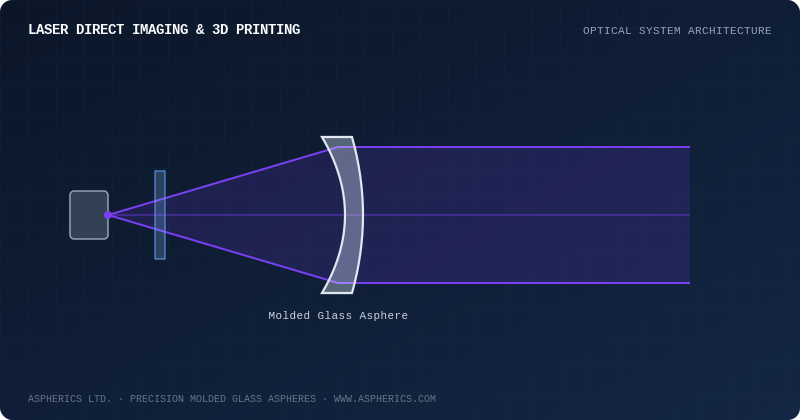
<p>Each diode is collimated by an asphere and the beam is either scanned (polygon or galvanometer) across the panel or the resin vat, or shaped and modulated in a multi-beam head. The spot at the work surface is set by the scan lens; the collimator sets the beam that fills it.</p><p>For 405 nm our laser diode modules are standard in the laser-welded version: stainless holder, ring and lens cell joined by spot welds with no adhesive anywhere.</p>

Key Advantages
- Violet designs. 405 and 408 nm lenses with NBAR-VIO and V-405.
- No adhesive near the facet. Laser-welded modules in 304L stainless.
- Glass optics. No yellowing or transmission loss under violet light.
- Full capture. NA up to 0.6 for high-power, wide-divergence diodes.
Recommended Catalogue Parts
Molded Glass Aspheric Lenses
| Part Number | DWL | EFL | NA | Engineering Fit | Action |
|---|---|---|---|---|---|
| AL-D0400-F0400-W405 | 405 nm | 4 mm | 0.4 | 405 nm, Ø4 mm, EFL 4 mm, NA 0.4: violet source collimator; welded module standard. | |
| AL-D0633-F0405-W445 | 445 nm | 4.05 mm | 0.63 | 445 nm, Ø6.33 mm, EFL 4.05 mm, NA 0.63: violet source collimator; welded module standard. | |
| AL-D06325-F0402-W408 | 408 nm | 4.02 mm | 0.6 | 408 nm, Ø6.325 mm, EFL 4.02 mm, NA 0.6: violet source collimator; welded module standard. |
Mounted Aspheric Lenses
| Part Number | DWL | EFL | NA | Engineering Fit | Action |
|---|---|---|---|---|---|
| MAB-D0400-F0400-W405 | 405 nm | 4 mm | 0.4 | AL-D0400-F0400-W405 in a M12 / M9 / M7 ×0.5 barrel, 12 configurations: screw into the diode socket and focus by rotation. | |
| MAB-D0633-F0405-W445 | 445 nm | 4.05 mm | 0.63 | AL-D0633-F0405-W445 in a M12 / M10 ×0.5 barrel, 9 configurations: screw into the diode socket and focus by rotation. | |
| MAB-D06325-F0402-W408 | 408 nm | 4.02 mm | 0.6 | AL-D06325-F0402-W408 in a M12 / M10 ×0.5 barrel, 9 configurations: screw into the diode socket and focus by rotation. |
Laser Diode Modules
| Part Number | DWL | EFL | NA | Engineering Fit | Action |
|---|---|---|---|---|---|
| LDM-D0400-F0400-W405 | 405 nm | 4 mm | 0.4 | 405 nm diode aligned to AL-D0400-F0400-W405: Ø3.8 / Ø5.6 mm can, laser welded or uv epoxy, pointing ≤ 1 mrad. | |
| LDM-D0633-F0405-W445 | 445 nm | 4.05 mm | 0.63 | 445 nm diode aligned to AL-D0633-F0405-W445: Ø5.6 / Ø9 mm can, laser welded or uv epoxy, pointing ≤ 1 mrad. | |
| LDM-D06325-F0402-W408 | 408 nm | 4.02 mm | 0.6 | 408 nm diode aligned to AL-D06325-F0402-W408: Ø5.6 / Ø9 mm can, laser welded or uv epoxy, pointing ≤ 1 mrad. |
Frequently Asked Questions
Why welded modules for 405 nm?
Adhesive near a violet diode facet can outgas and contaminate it under illumination. Welded modules have no adhesive at all.
Are the lenses suitable for watt-class diodes?
Molded glass handles the power of single-emitter diodes. State the power with your quote and we recommend the lens and coating.
Do you supply scan lenses?
No; we supply the collimators and aligned sources that feed them.
Related Applications
Molded glass aspheres that turn a diode's divergent output into a clean, round-ish collimated beam, 405 to 1550 nm.
Excitation optics for flow cytometers and bio-analytical instruments at 405, 445, 520 and 635 to 650 nm.
Dot and line projectors for triangulation sensors, 3D profilers and structured-light vision.