
Precision glass molding
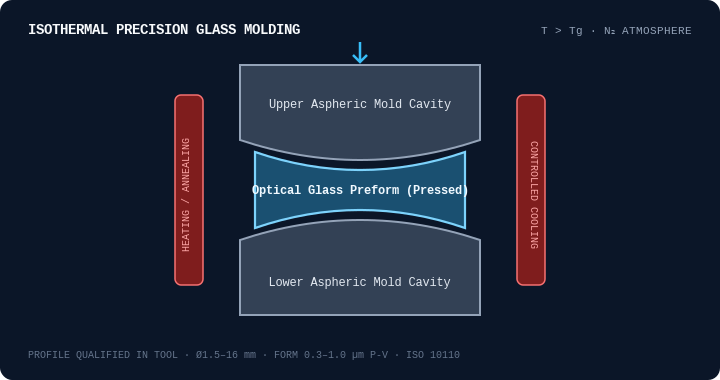
Isothermal molding of optical glass: the aspheric profile is qualified once, in the tool, and replicated in every pressed lens.
Molding process
A glass preform is heated with the mold tools and pressed above its transition temperature. The aspheric profile is cut and qualified in the tool, not re-created on each part, so pressed lenses replicate the released geometry lot after lot. Both surfaces can be aspheric, which lets one element correct a high-NA collimator through the diode window.
Molding lowers the refractive index of the glass slightly. The shift is measured and compensated in the optical design, and the cooling schedule is controlled so the compensation holds across production. The outer diameter is then ground to the drawing tolerance, typically +0 / −0.02 mm, as the mounting reference.
Catalogue lenses cover Ø1.5 to 16 mm and focal lengths from 1.14 to 32 mm; see the lens catalogue. Larger formats and custom profiles are reviewed on request.
Controlled Process Specifications
Related Technical Notes
What an RMS wavefront specification at 632.8 nm means for beam quality, how to convert it between wavelengths and how it relates to surface form.
A plane window in a diverging beam shifts focus and adds spherical aberration that grows with the fourth power of NA. Why high-NA collimators are designed for one window.
Codes 0/ to 6/ explained with values from catalogue drawings: stress birefringence, bubbles, homogeneity, form, centring, surface imperfections and laser damage.
Frequently Asked Questions
Are both surfaces aspheric?
On most catalogue designs, yes. Some designs use a spherical or plano second surface; the lens page states the surface types.
Which glasses do you mold?
Low-transition-temperature molding glasses from CDGM, NHG and OHARA, chosen per design for index, dispersion and moldability.
Ready for DFM Review or Custom Production Quote?
Send your ISO 10110 drawing, Zemax file, or optical target specification. NDA available on request.