
Mounting molded aspheres
Datums, pocket clearance, focus resolution and the five retention methods used in threaded barrels, with the tolerances that decide pointing and focus.
The mechanical datum
A molded asphere is centred by its ground outer diameter and located axially by a flat land. In a barrel, the lens sits in a pocket bored just over its diameter and rests on a machined shoulder. On catalogue barrels the pocket is the lens diameter +0.015 / +0.025 mm, so the lens can decentre by only a few micrometres.
A lateral offset δ between the lens axis and the emitter tilts the collimated beam:
θ ≈ δ / f
Where pointing error comes from
At a 4.47 mm focal length, 1 mrad corresponds to 4.5 µm of offset. Diode datasheets usually allow the emission point to sit tens of micrometres off the package axis; 50 µm gives 11 mrad (0.64°). A barrel therefore cannot point the beam better than the diode allows. It controls focus and the decentre of the lens itself. Where the beam must point along a mechanical axis, it has to be aligned on the live beam, as in a laser diode module.
Focus by thread
The M9 and M12 × 0.5 threads advance 0.5 mm per turn, 1.39 µm per degree of rotation. Defocus δz makes a collimated beam converge or diverge:
Δθ ≈ D · δz / f²
For a 3.85 mm beam from a 4.47 mm lens, 1 µm of defocus adds about 0.19 mrad, and one degree of rotation about 0.27 mrad. Focus by rotation while watching the far-field spot, then lock the thread with adhesive or a set screw.
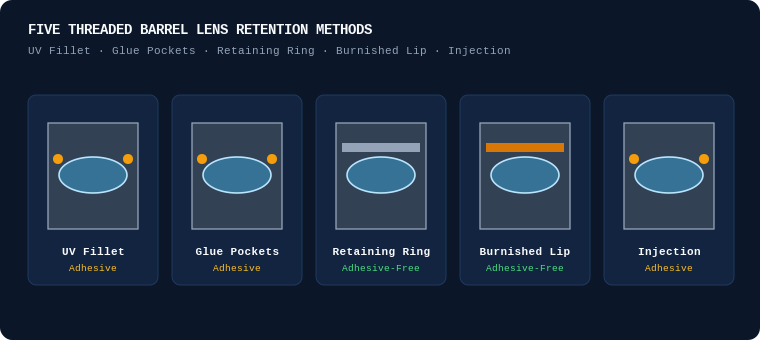
Retention methods
| Method | How the lens is held | Adhesive | Typical choice |
|---|---|---|---|
| UV fillet | UV-curing adhesive, 3 × 120° fillet between the front land and the pocket wall | Yes | Catalogue standard; smallest envelope |
| Glue pockets | Adhesive in 3 pockets cut in the pocket wall | Yes | Front face kept free of adhesive |
| Retaining ring | Threaded ring from the rear against a machined front lip | No | Serviceable; barrel slightly longer |
| Burnished lip | Brass lip rolled over the lens edge | No | Permanent, clean; volume production |
| Injection | Adhesive injected through a side hole into a groove on the lens OD | Yes | Land and optics stay clean |
Adhesive-free retention suits sealed housings and short wavelengths, where outgassing is unwanted. Bonded retention gives the smallest envelope and the lowest cost. Every combination of thread and retention has its own dimensioned drawing in the mounted lens catalogue.
Temperature
Aluminium expands at about 23 ppm/K and brass at about 19 ppm/K, against roughly 6–10 ppm/K for molding glasses. Over temperature the pocket clearance grows, bonded joints take up the difference, and the spacing between emitter and lens changes with the metal between them. Over 40 K, 5 mm of aluminium changes by about 4.6 µm, which in the example above is close to 1 mrad of added divergence. Keep the metal path between the diode flange and the lens short where focus must hold over temperature.
Frequently Asked Questions
Retaining ring or adhesive?
A ring or a burnished lip where adhesive is unwanted, for outgassing or rework. A UV fillet or glue pockets for the smallest envelope and lowest cost.
Can a barrel set the pointing?
No. Pointing is set by where the emitter sits in the diode package; a barrel sets focus. For pointing to a mechanical axis, use a laser diode module.
Can you make a barrel to our housing?
Yes. Send the housing interface; we quote a barrel or cell built to it.
Recommended Catalogue Parts
Related Technical Notes
Focal length sets the beam size, NA sets how much of the fast axis is captured, and the emitter sets the divergence. With a worked example from the catalogue.
Why a collimated diode beam points off-axis, how active alignment sets focus and pointing on the live beam, and what the fixing method changes.
Codes 0/ to 6/ explained with values from catalogue drawings: stress birefringence, bubbles, homogeneity, form, centring, surface imperfections and laser damage.